
Three noble Houses, one secret council
Council of Serpents
You are not one of the Houses. You sit on the Council that moves them, with a secret Ambition: make one House triumph, or make one collapse. The others want something else, and nobody says what.
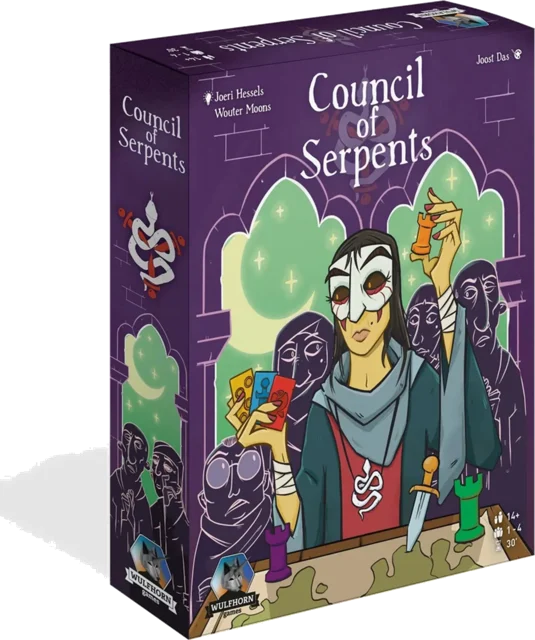
Three Houses.None of them is yours.
Everyone plays cards on the same three Houses. You win by pushing the one on your Ambition card over the edge, without letting the others read which one.
What you want, and how it ends.
A secret Ambition
You get two Ambition cards (one in 4 players), such as «Jane collapses» or «Rowel triumphs». Nobody sees them until the end.
Three values, 1 to 12
Each House has 💰 Wealth, ❤️ Popularity and ⚔️ Strength on its board. Every card pulls them up or down, like a tug of war.
A sudden ending
The moment a value goes above 12 that House triumphs; below 1, it collapses. The game ends right there, Ambitions are revealed, and whoever holds the matching one wins.
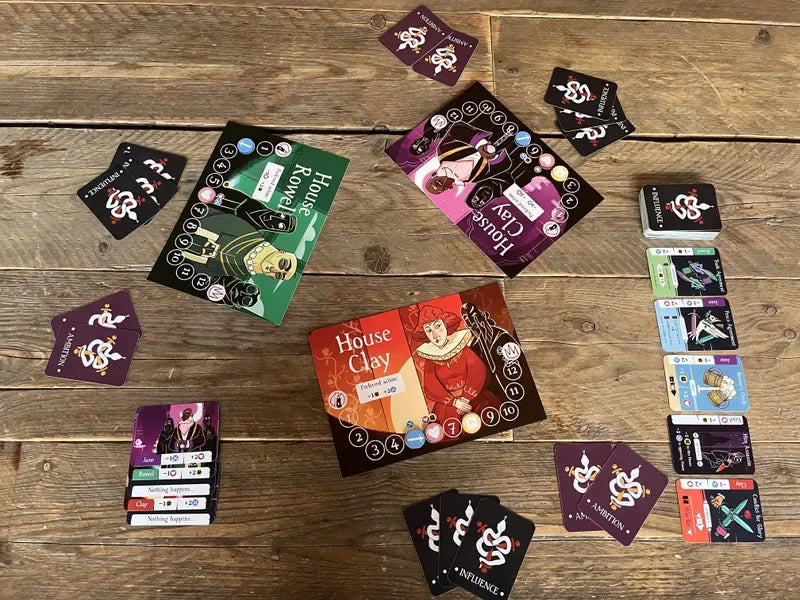
A deck, three boards, few pieces.
Influence cards: the whole game
House boards and value markers
Ambitions, plus the Keeper of Balance
starting Time track cards, with its board and the Court board
solo cards (Serpentess, Windfall, Struggle) and Tiebreakers
player aids, plus the solo reference and active player marker
The game in seven answers.
Open drafting from the Court, cards with two uses, a shared action queue (the Time track).
The turn ↓Three steps per turn. The hard part is reading the others and timing the push.
You never hit a player: you move the Houses the others need. In 4 you play in teams of two.
Ambitions are dealt at random and the Time track is shuffled. You choose from four open cards and decide what goes into the Time track.
The starting values are printed on the boards and always the same; who wants what, and the Time track, change every game.
2 and 3: two Ambitions each. 4: teams. Solo against an automa. Too few BGG votes yet for a best count.
Solo ↓Most effects are icons and numbers; Intrigues, Agreements and Planning cards have a sentence to read.
A real card ↓Everyone and no one: all players play cards on all three, and at the end of each turn the Time track makes them act on their own.
Take one, play one, time moves.
- Take a card from the Court. Four Influence cards lie face up: you take one, the others slide left and a new one is revealed.
- Play one Influence card and apply the effect at its bottom. There are five kinds, each played in its own place (below).
- Time elapses. You resolve the top card of the Time track: a House gains and loses something, or the House with the most of a value acts, or all Guilds activate. Sometimes it says «Nothing happens…», and nothing happens.
Conflict
between two HousesThe first one shifts a value between them. The second one between the same two starts a War, for 💰 or ❤️.
Intrigue
face down at a HouseRevealed only when that House goes to War: assassins, traitors, brutal tactics, healers.
Agreement
between two HousesPeace removes a Conflict, or reveals and discards the Intrigues. Trade removes the Conflict and both Houses gain 1.
Guild
at a HouseA small faction that raises a value at a cost. If it already supports another House, you steal it: the old one pays a penalty.
Planning
on the Time trackChange of Plans swaps a Time track card for one from the Court. Thriving Guilds goes on the track and activates every Guild.
When the Time track runs out, you all write the next one together, each with a face-down card.
- Each player draws a card from the deck and adds one from their hand, face down.
- The first two cards of the Court and the top card of the deck are added. In 3 players that makes 6 cards.
- Shuffle and lay them out one by one. A card naming a House already on the track is discarded: each House acts at most once.
- A House left out of the track immediately performs the preferred action printed on its board.
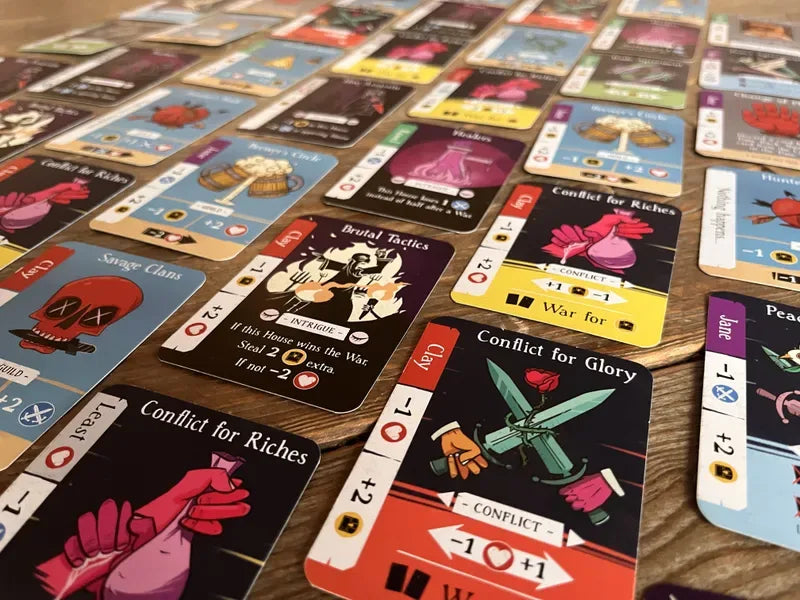
A real Intrigue card, as printed: «−1 💰 to this House, −2 ⚔️ to opposing House». On the left, its Time track side: «Most ❤️: +1 ⚔️».
A War between Clay and Jane.
Goal: one of your two Ambitions must come true. A House goes above 12 or below 1 and the game ends at once. In the real game the others play too, each with their own secret Ambition.
What you see: the three Houses with their values (the bar fills from 1 to 12), the Conflict between Clay and Jane, the face-down Intrigues, the Time track card that will resolve at the end of your turn, your hand and your Ambitions. Buttons only play what the rules allow at that moment.
💰 Wealth❤️ Popularity⚔️ Strength👑 above 12: triumphs☠ below 1: collapses
Situation 1 is the War example from the rulebook (Clay 3 💰 and 9 ⚔️, Jane 5 💰 and 4 ⚔️, Hire Assassin at Jane); Popularity values and the Time track card are ours. Situations 2 and 3 use our own numbers with the same rules. Card texts are as printed. Here you play alone: in the real game the others play between your turns.
Who wins, and when?
Checked twice
After each card is fully resolved, and in a War right after the Intrigues are revealed: an assassin can make a House collapse before the fight.
Shared victories
Everyone who fulfilled an Ambition wins. One War can make a House triumph and another collapse at the same moment, and both players win. Rarely, no one wins.
In 4, in teams
First and third against second and fourth, one Ambition each, hidden even from your partner. You may talk freely, but the others hear everything. In 3, experienced players can add the Keeper of Balance: they win if the deck runs out.
Keeping the realm together, against the Serpentess.
A real automa. You are the Keeper of Balance: you win if the Influence deck runs out, you lose the moment any House triumphs or collapses. Your turns, the Time track and the ending work as in the multiplayer game.
Her turn
She has no hand. She flips a card from her deck: the number, 1 to 4, says which Court card she plays. She starts the game.
Where she plays it
The reference sheet gives two options for each kind of card: A if she can, otherwise B. She looks for the House with the most or least of a value; ties are broken by the Tiebreaker cards at each House.
Your turn alone
She pushes the Houses towards the edges; you take from the same Court and play to bring them back, with one eye on the Time track. Windfall cards help you, Struggle cards make it harder: both go onto the Time track.
| Difficulty | Influence cards removed | Windfall | Struggle |
|---|---|---|---|
| Wormtongue | 25 | 5 | 0 |
| Spymaster | 20 | 3 | 1 |
| Master of Whispers | 10 | 1 | 3 |
| Lady/Lord of Shadow | 0 | 0 | 5 |
Fewer cards removed means a longer deck to survive; Windfall and Struggle cards go into her deck, not the Influence deck.
The rules in seven minutes.
A rules explainer by BoardgameNinja, in English.
Is it for you?
You will like it if
- you enjoy bluffing and reading the table more than building your own engine
- you want real tension in 30 minutes
- you like games where everyone plays on the same pieces
- you want a solo mode with an automa, not just a score to beat
Maybe not if
- it annoys you when another player ends the game with one card
- you want a board of your own to grow
- at your table nobody reads English: some cards have a line of text
- a shared win, or no winner at all, leaves you cold
The frog’s advice
First game in three, two Ambitions each. Before every card, look at the top of the Time track: it often decides more than your hand. And do not push the same House every turn: they will read you.
What people ask before buying
What is Council of Serpents?
A competitive card game with hidden goals for 1 to 4 players by Joeri Hessels and Wouter Moons, illustrated by Joost Das, published by Wulfhorn Games. Ages 14 and up, about 30 minutes. Three noble Houses compete for power; you are a member of the Council that manipulates them to fulfil a secret Ambition.
How do you win?
Each player has secret Ambition cards such as «Jane collapses» or «Rowel triumphs». A House triumphs when one of its values goes above 12 and collapses when one drops below 1; the game ends at once, Ambitions are revealed and everyone who fulfilled one wins. Rarely no one wins.
How does a turn work?
Take one of the four face-up Influence cards from the Court, play one Influence card from your hand, then resolve the top card of the Time track. When the Time track is empty, all players form a new one together.
How does a War work?
A second Conflict card between the same two Houses starts a War for Wealth or Popularity. Intrigues at both Houses are revealed; the House with more Strength takes the difference in Wealth or Popularity from the other (no more than it has); then both halve their Strength, rounding up, and the cards are discarded. Example from the rulebook: Clay with 9 Strength against Jane with 4, Hire Assassin at Jane: Clay drops to 7, Jane pays 1 Wealth, Clay takes 3 Wealth, then they end at 4 and 2 Strength.
What is the Time track?
A row of cards that makes the Houses act on their own: one card is resolved at the end of each turn. Every Influence card has a Time track effect on its left side. When the track runs out, each player draws a card and adds one face down, two Court cards and one from the deck are added, everything is shuffled, duplicates of the same House are discarded, and Houses left out perform their preferred action.
Can you play it solo?
Yes, against the Serpentess, an automa that plays a Court card chosen by her own deck and places it following a priority sheet. You are the Keeper of Balance: you win if the Influence deck runs out and lose if any House triumphs or collapses. Four difficulty levels, from Wormtongue to Lady/Lord of Shadow.
How does it play with 2, 3 or 4?
In 2 and 3 players each receives two Ambitions. In 4 you play in teams, first and third against second and fourth, with one Ambition each hidden even from your partner. In 3 there is an optional Keeper of Balance Ambition for experienced players. BGG has too few votes yet to say the best count.
How much luck is there?
No dice. Luck is in the Ambitions you are dealt, the cards that reach the Court and the shuffled Time track. You choose among four open cards and decide which card you add to the Time track.
How much English is there?
It is the English edition. Most effects are icons and numbers; Intrigue, Agreement and Planning cards have a short sentence, and the solo mode uses a written reference sheet.
What is in the box?
3 House boards, 9 attribute markers, 63 Influence cards, 6 Ambition cards plus the Keeper of Balance, 5 starting Time track cards, Time track board, Court board, 4 player aids, 24 solo cards (Serpentess, Windfall, Struggle), 3 Tiebreaker cards, the Serpentess reference and an active player marker.
The Council is in session. Which House do you push?
Our assistant has read the Council of Serpents rulebook. Ask whatever you like: you stay on this page.


