
The cooperative game where you create a language
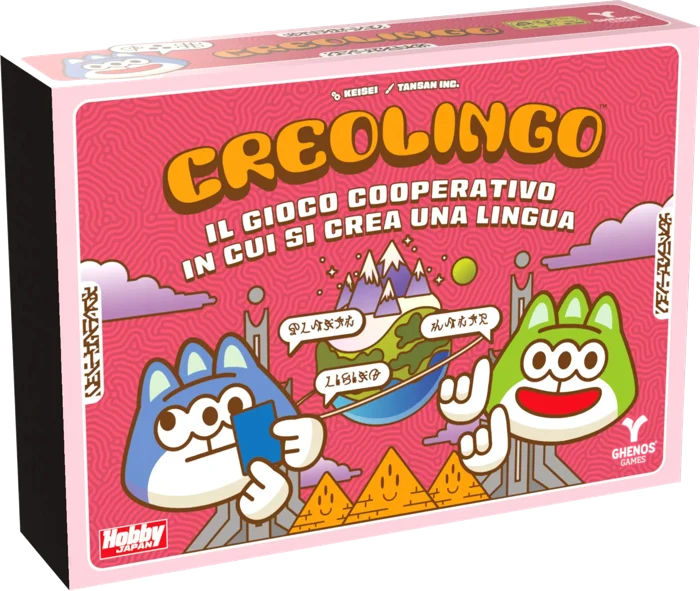
Creolingo
You are prehistoric nomads with no common language. Together you invent one, word after word, and one of you at a time tries to teach the others something new using only that language. The Italian edition of Gibberers.
Poipa Yanyan.«I know.» The first two words of every civilization.
You don’t guess words.You invent them.
The language you play with does not exist when you open the box. By the end of the evening it has a dictionary on the table, and you wrote it.
How a language is born.
Generation Zero: 18 words
Taking turns, you create the first 18 Words. A Word is a pronunciation you make up plus a meaning, chosen by looking at the cave drawings on the Generation 0 cards. Four are compulsory: yes, no, I, know.
The Mentor explains
One player is the Mentor: they draw a Knowledge card, choose one thing to teach, give it a new name and explain it using only the New Language. The others, the Students, guess.
The language grows
Every word taught, guessed or not, goes into the dictionary. Generation after generation the things to explain get harder: from the sun and ants to wine, cameras, franchises.
The same game, in Italian.
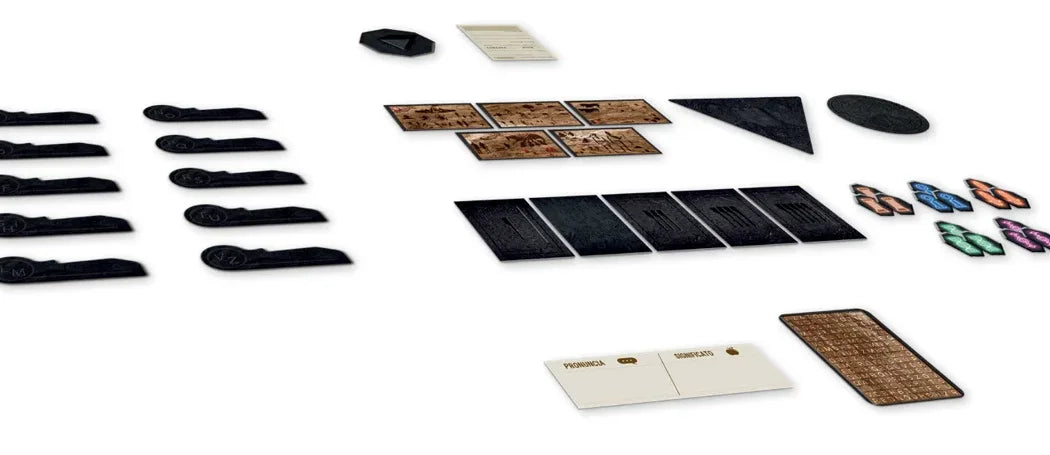
Same designer (Keisei), same illustrations by TANSAN, same components one by one, with two rulebooks: base and expert. What changes is the box design and the language: in Creolingo cards and rules are in Italian.
| Creolingo | Gibberers | What it is |
|---|---|---|
| 5 Spiegazione tokens | 5 Enlighten Tokens | pay for answers and hints |
| 10 Index tiles | 10 Index Tiles | the dictionary, by letter |
| 5 pads of Word notes | 5 Word Sticky Notes | one word per note |
| 61 Development tokens | 61 Development Tokens | your civilization’s progress |
| Board, Mentor marker, Civilization pad | Civilization Board, Mentor Marker, Record Booklet | tokens, turn, game record |
The game in eight answers.
Paper and pencil: you write every word on a note. The Mentor role passes left every turn.
The turn ↓Few rules. The hard part is making yourself understood with the words you have.
You win or lose together. Everyone takes turns as Mentor, the others work out the answer together.
Knowledge cards are drawn at random, but the Mentor picks one of the five things on the card and may redraw once (expert rules).
76 cards, five things to teach on each Knowledge card, and the words are always yours.
According to BGG voters. No solo mode: you need at least one Mentor and two Students.
The Knowledge cards carry words to teach, so the language of the box matters: this edition is fully Italian.
No: you need to remember what you decided. The words lie on the table as notes, sorted by first letter under the Index tiles.
Prepare, explain, write it down.
- Preparation. The Mentor draws from the lowest Generation deck, secretly chooses one of the five things on the card and writes a new pronunciation for it. The Students put Enlighten tokens on the board: 5 in Generation 1, then one fewer each generation.
- Explanation. Only the New Language may be spoken, by everyone. The Mentor can add a Support Word with no meaning and, in the first generations, use gestures. To answer: say «I know» in the New Language, give a token to the Mentor, answer in your own language. The Mentor replies in the New Language.
- Application. Italian is allowed again. Guessed: you take the Development tokens shown on the card. Tokens run out: the explanation fails. Either way the meaning is written on the note and it goes into the dictionary.
During the explanation your own language is forbidden. For everyone, the whole time.
Ancestor
1 tokenSomeone points at one drawing on the Generation 0 cards.
Telepathy
2 tokensThe Mentor writes what the Support Word means.
Inspiration
3 tokensA new word is added to the dictionary and can be used straight away.
Hints and token numbers come from the expert rulebook; each hint can be used once per word. The Italian names of the hints may differ in the box.
What is «Toporla»?
Goal: you are a Student. Understand what the Mentor is teaching before the Enlighten tokens run out. In the real game a success gives Development tokens, and in the base game the last explanation of Generation 3 decides whether you all win.
What you see: the Mentor’s sentence (yellow word = the one to guess), the Word note of the word you tap, the tokens left, your dictionary sorted by letter, the Mentor’s reply. Hints and answers are buttons, each with its cost.
«Toporla» is the example in the rulebook: the words, the Telepathy hint, «Dog» and «Cat» are as printed; the other wrong answers are ours. «Bobori» and «Zabi» are words of our own with the same rules. Here the Mentor is played by the page.
Pegoshi. Pegoshi. Pero!«No. No. Yes!» The Mentor’s face when you finally get it.
Base game or expert game?
Base
After Generation Zero you develop new words over three generations. The game ends after one Generation 3 Knowledge card: if that last explanation succeeds, you have won. Whatever happens, you leave with a language of your own. It is the shorter game and the one to start with.
Expert
- Five generations, from prehistory to the future: 4, 5, 3, 2 and 1 cards per generation.
- It ends after a Generation 5 card. No win or loss: you score your Development tokens (1 point each, Wonders 3, plus 4 for each set of the four kinds).
- With 2 tokens of the same kind, or 1 Wonder, you can create an extra word.
- Four levels of civilization, from 24 points up to 67 and more.
See a game explained.
The official how-to-play by Meeple University, in English, on the English edition (Gibberers): same rules.
Is it for you?
You will like it if
- you like games where you win or lose together
- your table enjoys talking, guessing and laughing at its own mistakes
- you want something that feels like no other game
- you are four or five
Maybe not if
- you are often only two: it needs at least three
- someone at your table hates speaking up or making odd sounds
- you want a winner among the players
- the expert game is long: plan a whole evening
The frog’s advice
First game with the base rules. In Generation Zero choose useful words for explaining (big, small, animal, eat, water…) and short pronunciations that sound different from each other: the rulebook suggests 1 to 4 syllables. You will need them all later.
What people ask before buying
What is Creolingo?
A cooperative word game for 3 to 5 players by Keisei, illustrated by TANSAN Inc., published in Italian by Ghenos Games. It is the Italian edition of Gibberers (Hobby Japan, 2024). Ages 14 and up, 60 to 180 minutes. You play prehistoric nomads who create a language together, from the first words to the technology of the future.
Is it the same game as Gibberers?
Yes. Same designer, same illustrations and the same components, with a base and an expert rulebook. The box design and the language change: Creolingo is fully in Italian, cards included.
How do you play?
In Generation Zero you create 18 basic Words: a made-up pronunciation and a meaning chosen from the drawings on the Generation 0 cards, including yes, no, I and know. Then in turn a Mentor draws a Knowledge card, picks one thing to teach, names it and explains it using only the New Language, while the other players guess. Every word, guessed or not, goes into the dictionary.
How do you win?
In the base game you develop words over three generations; the game ends after one Generation 3 Knowledge card, and if that last explanation succeeds you all win. In the expert game there is no win or loss: you score the Development tokens earned and find out your civilization’s level.
What are the hints?
During an explanation the Students can spend Enlighten tokens: 1 to look at a drawing on the Generation 0 cards, 2 to have the Mentor write the meaning of the Support Word, 3 to add a new word to the dictionary. Each hint can be used once per word, and each answer costs 1 token.
Can you use gestures?
In the expert rules the Mentor can use gestures only in Generations 1 and 2. During the explanation everyone may speak only the New Language.
How many players are best?
3 to 5. BGG voters prefer 5. There is no solo mode: you need a Mentor and at least two Students.
How long is a game?
The box says 60 to 180 minutes. The base game is the shorter one, the expert game with five generations is the longer one.
Do I need to be good at languages?
No. You need to remember what the group decided: words are written on notes and laid out on the table by first letter, under the Index tiles.
How much luck is there?
No dice. Knowledge cards are drawn at random, but the Mentor chooses which of the five things on the card to teach, and in the expert rules may redraw once.
What is in the box?
1 board, 10 Index tiles, 5 Enlighten tokens, 61 Development tokens, 1 Mentor marker, 10 large cards, 76 standard cards, 5 pads of Word notes, 1 Civilization pad, a base rulebook and an expert rulebook.


