
Duel of Meloch
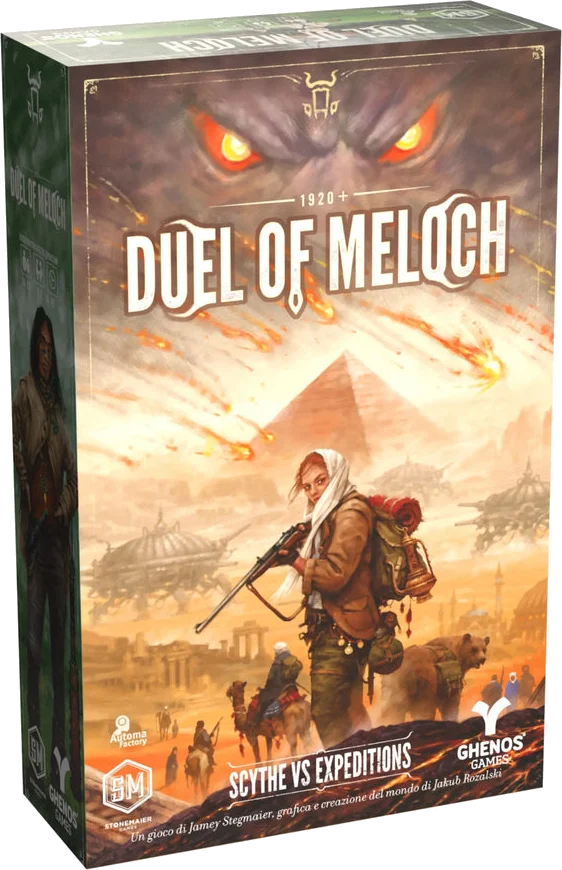
A duel for two in the 1920+ world: one plays by the rules of Scythe, the other by those of Expeditions, on the same small map. The first to place 4 stars on the Triumph Track wins on the spot. By Jamey Stegmaier, art by Jakub Rozalski.
Choose your side.
The two players do not play the same game. Choose yours: the page will speak to you from that side, and the trial further down will make you play it.
The box has everything for one Scythe player and one Expeditions player: a new faction, a new mech with its character and companion, cards, a double-sided map and the solo opponent. If you own them, you can use their factions and mechs too, and this box adds content to both.
What do you play with?
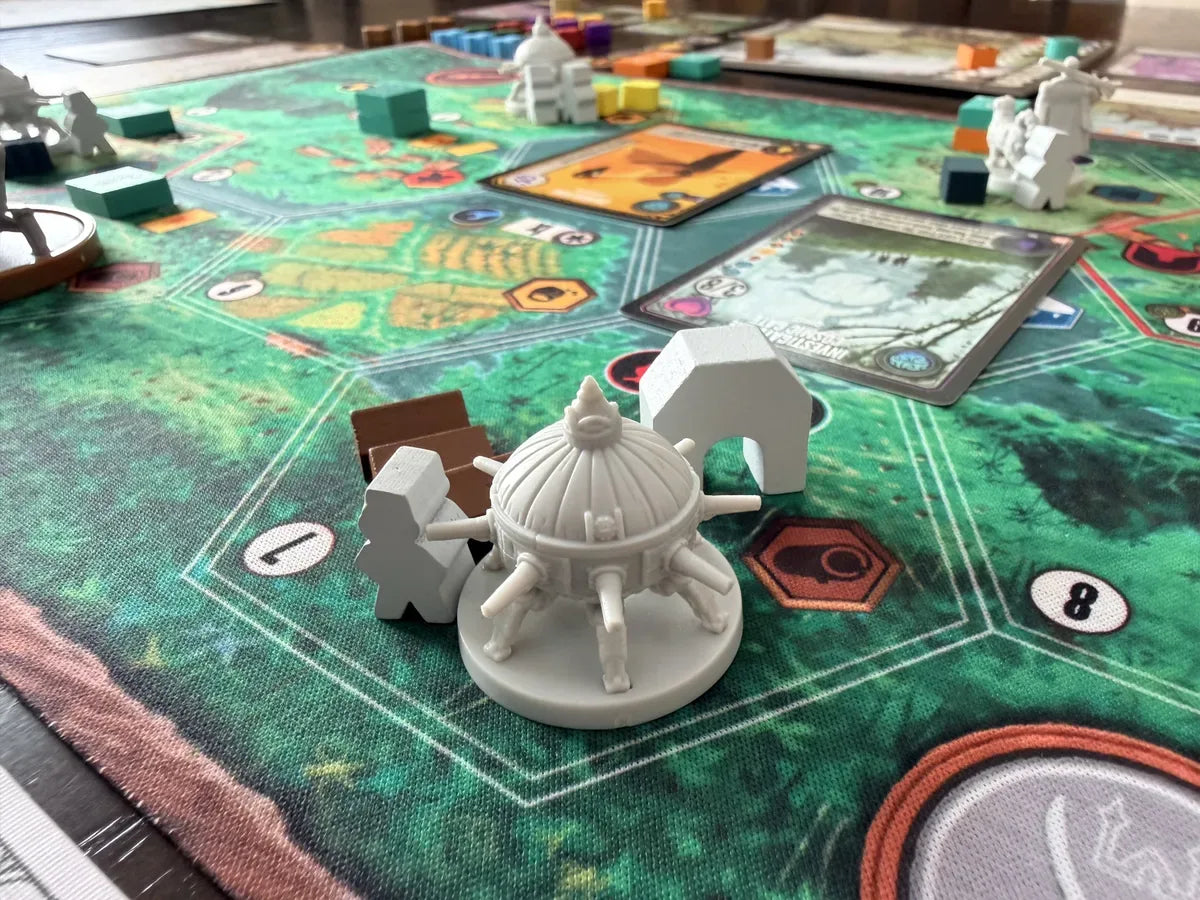
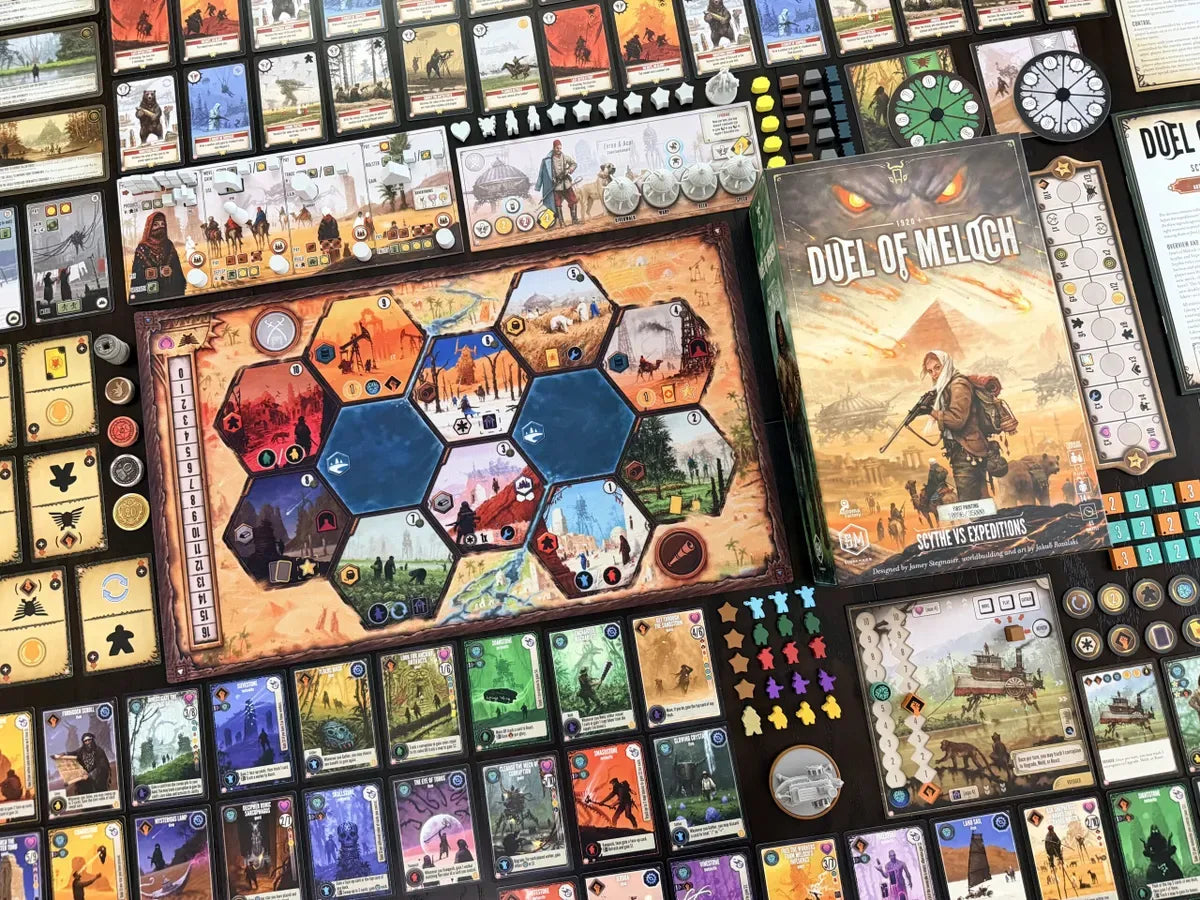
The game's words, in one minute
The bar with 8 categories; each has one goal for Scythe and one for Expeditions, such as winning a combat or holding enough coins. Only one star per category, for either player: whoever takes it closes it.
The 4th star wins the game instantly. There is no final scoring.
A wheel where each player secretly sets how much power to spend in a combat, from 0 to 7.
60 cards of 8 kinds. In combat they add their value and an effect; during your turn you can discard them for a benefit.
When your opponent places their 1st, 2nd or 3rd star, you draw one: you turn it the way you prefer, place it over half of the last Meloch card, and take the benefits facing you. It is the catch-up for whoever is behind.
Face-down tokens on 6 locations. For Scythe they are encounters (cards with choices that give benefits); for Expeditions a hidden bonus, and the mech must stop there.
Stacks of tokens on 6 locations, only for Expeditions: you pay power or guile (the second Expeditions resource, beside power) to take them, and the last one uncovers a benefit.
For Scythe the character and the mechs; for Expeditions the single mech. Workers are units but do not fight.
An Expeditions benefit: pay to take the top corruption of your location, or attack the Scythe character or mechs there.
The game in eight answers.
Scythe: action selection and area control. Expeditions: card play and exploration. In common: combat with dial and cards, and the race to 4 stars.
↓Depth3.5 of 5 on BGGEach player must learn one of the two rulebooks, and it helps to know how the other side moves and fights. Short games, dense choices.
↓InteractionVery high, head to head10 locations, combat, stolen cards and encounters that hit the other player. The rulebook says it is much more direct than Scythe and Expeditions.
↓LuckIn the cards drawnNo dice: combat is decided by dial and cards chosen in secret. Luck is in combat, encounter, discovery and Meloch cards drawn.
↓ReplayabilityTwo-sided map and trackPlus all factions and player mats of Scythe and all mechs and characters of Expeditions, if you own them.
↓LanguageText on cards, in ItalianEncounter, discovery and combat cards have text, according to BoardGameGeek a moderate amount. This is the Italian edition.
↓SoloA real automa, 5 levelsBy Morten Monrad Pedersen and team: it plays the other side, attacks and races for the stars.
↓PlayersTwo, or soloIt is built for two: 45 minutes, and every turn counts.
↓What do you do on your turn, as Scythe?What do you do on your turn, as Expeditions?
One section of your mat
You move your action token to one of the 4 sections (it must change) and take its top action, its bottom action, both or neither, paying the cost first.
- Top: Move (one different unit per movement), Bolster (power or combat cards), Trade (resources or popularity, the track of how much people like you), Produce (resources where your workers are).
- Bottom: Upgrade, Deploy a mech, Build a structure, Enlist a recruit.
What changes in the duel
- No objective cards and no end-of-game scoring: only the 4 stars count.
- You place a star as soon as you meet a category's goal.
- Map tokens are your encounters; with Sweep you remove face-up cards the opponent wanted.
- If the Expeditions mech is on a location with your workers, it controls it: you cannot produce there.
Two of three actions, or Refresh
Your action token covers one of three actions, Move, Play and Gather: you take the other two. When you want, you Refresh to take back cards and workers, and next turn you take all three.
- Move: 1 to 3 locations; you stop on a map token and take its hidden bonus.
- Play: a card from your hand, taking its power/guile and, with a worker, its ability.
- Gather: the benefits printed on your location, such as Vanquish.
What changes in the duel
- To place a star you need a Boast benefit, except when you win a combat.
- Combat cards are a new Gather benefit and a map token bonus.
- You cannot cross tunnels or lakes, but you cross rivers.
- You start with a hero worker, which counts as any colour.
A race to 4 stars, and you steal the categories.
One star per category
The Triumph Track has 8 categories, each with a goal for Scythe and one for Expeditions, and only 1 star fits in each, whoever places it. Taking a category also takes it away from the other.
At the table: Which one do I close before they get there?
Combat is worth a star
Whoever wins places a star, if the combat category is still free (on side A of the track there is only one); whoever loses goes back to base. Scythe can play more cards, so Expeditions has to choose its moments.
At the table: Do I attack now, or do I wait to have more cards?
The one behind gets help
Each of the opponent's first three stars gives you a Meloch card with its benefits.
At the table: Do I place this star now, giving them a card?
Getting in each other's way
Scythe can Sweep the face-up cards Expeditions wanted and has encounters that lower the opponent's tracks; Expeditions can take control of a location full of Scythe workers.
At the table: Do I advance, or do I slow them down?
If one player is much more experienced (dozens of Scythe games against a first Expeditions game), the rulebook suggests the newer player wins with 3 or even 2 stars.
A combat, from your side.
Your goal: win the combat spending as little power as possible: whoever wins places a star, and the power on the dial is paid even if you win.
The combat rules are the real ones: dial from 0 to 7, up to one card per combat unit for Scythe and up to one for Expeditions (plus the one added by Ambush), the attacker wins ties, card values and effects as in the Appendix. Situations, hands, the opponent's choices and the card drawn by Element of Surprise are examples; without the guide the opponent chooses at random. Card names are our own translation: in the Italian box they may differ.
Does it work solo? Yes, against a real automa.
Where the challenge comes from
From an «Automa», designed by Morten Monrad Pedersen with Lines J. Hutter and Lieve Teugels. You play one side, Scythe or Expeditions, and the Automa plays the other: there is one for each. You only need to know the rules of your side.
What changes
The Automa does not use mats and resources: it is driven by 20 Automa cards and 6 phase cards. A progress track tile covers 5 categories of the Triumph Track: there the Automa does not meet the goals, it advances its workers along 5 tracks, and when one reaches the star it places it.
Your round alone
You play your turn as usual. On its turn the Automa draws an action card: if it is a phase card it follows it; otherwise it draws a support card and resolves the first possible action of the top row, then of the second row. When it attacks, it moves its units to the location where its estimated strength exceeds yours the most, and fights; if the advantage is too small, it does not attack. So you must watch where your combat units stand.
How you win
As in two-player: the first to 4 stars wins. Difficulty goes from 1 to 5; the rulebook suggests level 2 for the first game. The level sets how many Automa cards go into its deck.
Do you own Scythe or Expeditions? Then it grows.
More factions and mechs
All Scythe factions and player mats and all Expeditions mechs and characters work here, with most of their encounter and discovery cards. Airships and the corrupted mech are not used.
Content for your games
The new faction, player mat, encounter, Factory (extra actions gained by visiting the Factory) and combat cards go into Scythe; the new mech, character, companion and discovery cards into Expeditions. The map is only for the duel.
Scythe vs Scythe, Expeditions vs Expeditions
With the other games you can duel on the same side, with the variants in the rulebook.
The Tournament of Meloch
A sheet for an elimination tournament: Scythe vs Expeditions in the first round, then the winners face each other.
Is it for you?
You will like it if
- you mostly play in two and want a tight, hostile duel
- you love Scythe or Expeditions and want them in 45 minutes
- you like asymmetry: two players, two different games
- you also want a solid solo mode
Skip it if
- neither of you wants to learn a full rulebook
- you prefer peaceful games where you build without being bothered
- you want to play in three or more
Take the side you already know.
Who has played Scythe takes Scythe, who has played Expeditions takes Expeditions. If one of you is much more experienced, use the rulebook variant: the newcomer wins with 3 or 2 stars.
What people ask before buying
What kind of game is Duel of Meloch?
A competitive duel by Jamey Stegmaier, art by Jakub Rozalski, published by Stonemaier Games, Italian edition by Ghenos Games. 1 to 2 players, 45 minutes, ages 14 and up, weight 3.5 of 5 on BoardGameGeek. One player uses the Scythe rules, the other the Expeditions rules, and the first to place 4 stars on the Triumph Track wins.
Do I need Scythe or Expeditions to play?
No. The box contains everything for one Scythe player and one Expeditions player, plus the solo Automa. If you own those games you can use their factions and mechs, and this box adds content to both.
How do you win?
By placing 4 stars on the Triumph Track, which has 8 categories, each with a goal for each side, and room for only 1 star in each. The 4th star wins instantly; there is no final scoring.
How does combat work?
Each player secretly sets their Power Dial from 0 to 7 and adds combat cards: Scythe up to one per combat unit, Expeditions up to one (Ambush adds another). The higher total wins, and the attacker wins ties unless a card says otherwise. The winner places a star if the combat category is still free (side A of the Triumph Track has only one), the loser goes back to base.
What are Meloch cards?
When your opponent places their first, second or third star, you draw a Meloch card and gain the benefits facing you. They help whoever is behind.
Is there a solo mode?
Yes, an Automa by Morten Monrad Pedersen and team, with one version for each side. Difficulty 1 to 5, with level 2 suggested for the first game.
How much luck is there?
No dice. Combat is decided by dial and cards chosen in secret; luck lies in the combat, encounter, discovery and Meloch cards drawn.
Is it hard to learn?
Each player learns one of the two rulebooks, with summaries included in the box. If one player is much more experienced, the newer player can win with 3 or 2 stars.
Which language is it in?
This is the Italian edition by Ghenos Games. Cards have text; an English edition is also sold separately.
Meloch has chosen the duellists. Which side are you on?
Our assistant has read the Duel of Meloch - ITA rulebook. Ask whatever you like: you stay on this page.