
Greenwood
Greenwood sells itself as a tourist paradise, but druids hold magical creatures captive there. Over 3 rounds you free them by night, and the player with the most points wins. You have very few actions: each member of your group does one thing per round.
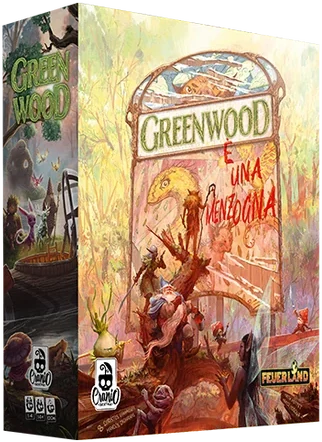
What do you play with?
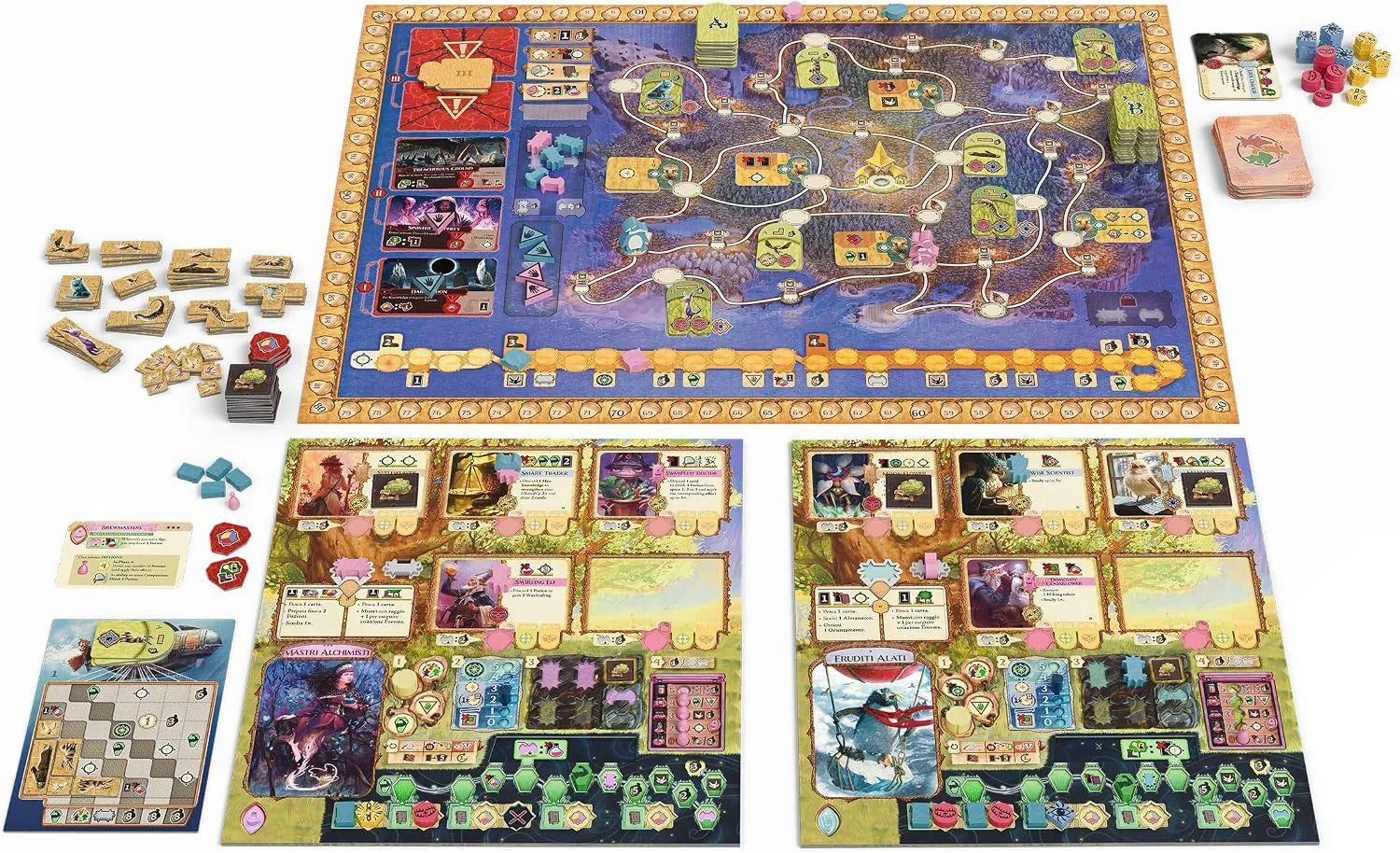
The pieces, in one minute
The cards you play on your board. In one Night each does one thing: uses its ability or goes to the forest.
Your piece on the board. It counts as an ever-present Companion with two fixed abilities to choose from, but cannot take Hiking.
A token that activates one of your Companions. You have 2 and can reach 4.
A token that copies a Companion another player already activated with Energy that Night and not yet copied, or their Spirit.
A token placed on a free Companion: your piece moves and takes the action of the space it reaches, and that Companion stays busy until freed.
A track that sets how far you move in the forest and grants bonuses along the way.
Tokens in three colours: Traps, Illusions and Hexes. Creatures need them and you can carry only a few.
Your personal grid: rescued creatures fit here, and covering certain spaces grants bonuses.
Markers that at the start of each Night give a spell (for example draw 1 card and score 1 point) or free a Companion. They are not spent.
Penalties for everyone, tied to specific actions. More arrive each round, and you can protect yourself.
The game in eight answers.
Each turn you use one token and decide what your Companions do. Rescued creatures become tiles to fit in your Submarine.
↓Depth3.2 of 5 on BGGThe basic rules are linear; clans, factions with their own powers, are an optional addition.
↓InteractionCompetitive and indirectNobody attacks. Spies copy a Companion someone has already used, and rescuing a creature takes it from everyone.
↓LuckNo diceLuck lies in cards drawn, creatures that appear and Threats revealed. You manage your hand with spells and discards.
↓Replayability7 clans, 15 Threats, 4 SubmarinesEach game uses 5 of 15 Threats and, with clans, as many clans as players. The Submarine changes grid and difficulty.
↓LanguageCard text, in ItalianCompanion abilities are written both as icons and as words. The player aid teaches the icons.
↓SoloA score to beatNo opponent plays: there is an imaginary second player whose Companions you can copy.
↓PlayersBest at 3, on BGGThe first two phases of a round are played all together, so you wait only at Night, one token each.
↓What happens in one round?
A game is 3 rounds. Each round has 5 moments, and the third, the Night, is where you act. You start at 5 points.
Dusk
All together. You have four effects, and each round you exclude one: play a Companion, strengthen your fellowship (advance on a track giving bonuses, more Energy and Spies, more Knowledge spaces), gain an Aurora by discarding a card, protect yourself from a Threat.
Departure
All together. Each Aurora gives you a spell or frees a Companion from its Hiking token. Auroras stay: they count again next Night.
Night
In turn, one token at a time. Energy activates a Companion of yours, a Spy copies someone else's, Hiking sends one to the forest to study, rescue creatures, free Lumen Sprites (one more tile for Submarine bonuses, and you may swap a Knowledge) or climb a Tower (+1 Wayfinding and an effect). When you cannot or will not do more, you pass.
Dawn
Each unused Energy and Spy is worth 1 point.
Return
Energy and Spies return, 2 new Threats are revealed and hands are adjusted to 5 cards. Companions with Hiking stay busy unless freed. After 3 Nights the player with the most points wins.
What do you do with few tokens?
Your goal: score as many points as possible this Night with the tokens you have. In the real game whoever has the most points after 3 Nights wins.
You score by rescuing creatures: you need the right Knowledge and must reach their space. One Night, just you. Each situation has a different forest and hand.
The way the Night is played is the real one, but without Threats or Tower effects. Forest, Companions, points and range threshold are examples. Other players do not act: you can only copy one of their Spirits.
Where are the decisions?
Ability or forest?
A Companion does one thing per Night. Sent to the forest, it stays busy into the next Night, unless an Aurora frees it.
At the table: Do I need its power or a forest action?
Spies come later
A Spy can copy another Companion only if it has already been used that Night. Another Spirit, however, can be copied even earlier.
At the table: Do I use my best Companion now, knowing it can then be copied?
An unused token is worth 1 point
At Dawn each Energy or Spy left is worth 1 point. Spending one pays only if it yields more than that point.
At the table: Is this move really worth more than a point?
Limited Knowledge
You start with two spaces. Taking a new one when full drops an old one, and each Knowledge costs a card from your hand.
At the table: Which creature am I really preparing for?
Where you fit it
Covering a space can give Energy, Wayfinding or another bonus, and completing a column or diagonal gives one more. A creature tile never moves again.
At the table: Do I take the bonus now or prepare the next one?
Giving up at Dusk
Each round you exclude one of four effects, and you cannot exclude the same one two rounds running.
At the table: What do I give up tonight?
Does every game change? With clans, a lot.
In the basic game everyone is the same. With clans you play your own board, each clan brings an extra rule, and only the chosen ones enter play.
Nature Elementals
Inspire Companions: that Companion rescues creatures using Inspiration as Knowledge, without spending it.
Bird Scholars
Write Almanacs: where they have one, they study without discarding and choose the colour.
Freethinkers
Charge Magic items on Companions: when you activate that Companion, you also get the item's effect.
Root Rebels
Produce Compasses, which give +1 Wayfinding on Towers, and bring Spells to Companions.
Brewmasters
Brew Potions to drink at Dawn: each gives an effect, such as points, Wayfinding or Study.
Fungus Pirates
Procure Provisions to fit in the Submarine: each gives a bonus as soon as you take it.
Meowmicry
No new rule: its Spirit copies the other clans' special spells.
Does it work solo? Yes, against your own score.
Where the challenge comes from
No automa contests creatures: the challenge is the score. You set up a two-player game, with an imaginary player receiving a board and 3 Energy.
What changes
At the start of each Night the other receives 1, 2 or 3 cards depending on the round, already activated. You can copy them with your Spies, as well as its Spirit. At Night's end they are discarded.
Your round alone
You play Dusk and Departure as usual. At the start of the Night you see which cards appeared and decide whether to keep Spies for them. Then you play the Night alone, with nobody taking a creature from you.
How you win
The rulebook judges your final points: up to 45 the druids are not too worried, 46 to 65 they are puzzled, 66 to 85 people at home take note, 86 to 104 you have followers, from 105 Greenwood is liberated.
Is it for you?
You will like it if
- you love doing a lot with very few actions
- you enjoy fitting tiles to earn bonuses
- you want to use others' powers instead of yours
- you appreciate a game that grows when you add clans
Skip it if
- you want direct conflict
- you want a solo mode with an opponent that plays
- you do not like learning icons and card text
For your first game, no clans.
The rulebook recommends it, with Submarine 0 and Threats 1 to 5.
What people ask before buying
What kind of game is Greenwood?
A competitive game by Christos Giannakoulas and Manolis Zachariadis, for 1 to 4 players, ages 14 and up, weight 3.2 of 5 on BoardGameGeek, Italian edition by Cranio Creations. Over 3 Nights you rescue creatures from a forest run by druids, and the player with the most points wins.
How does a turn work?
At Night you use one token at a time: Energy activates a Companion of yours, a Spy copies another's, Hiking sends a Companion to the forest for an action. Then the next player goes.
How do you rescue a creature?
You reach its space with a forest action and discard the required Knowledge. You take the points and fit its tile in your Submarine: covering certain spaces grants bonuses.
What is the difference between the basic game and clans?
In the basic game boards are identical and there is a 55-card Companion deck. With clans each player has their own Spirit and mechanic, with Potions, Compasses, Almanacs and more. The rulebook recommends starting with the basic game.
Is there a solo mode?
Yes. You play against the score, with an imaginary second player who each Night receives 1, 2 or 3 already activated cards you can copy with Spies. From 105 points Greenwood is liberated.
How much luck is there?
No dice. Luck lies in cards drawn and in the creatures and Threats that appear. Spells, discards and adjusting your hand keep it under control.
Do players interfere with each other?
Little, and indirectly. Nobody attacks and pieces do not block. Rescuing a creature takes it from the others, and Spies use others' Companions.
How long does it last and what is the best player count?
BoardGameGeek lists 40 to 160 minutes, 1 to 4 players, and the best count is 3. There are always 3 rounds.
What should I do in the first game?
The rulebook recommends the basic game, Submarine 0, the easiest, and Threats 1 to 5 in the given order.
Which language is it in?
This is the Italian edition by Cranio Creations.
Greenwood is a lie. Who will expose it?
Our assistant has read the Greenwood rulebook. Ask whatever you like: you stay on this page.