
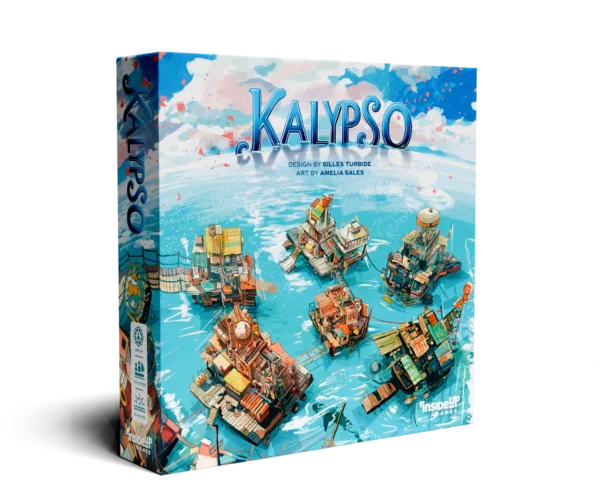
Kalypso
The world is under water. You build a floating town with whatever the ocean brings you.
A tile-laying game in four rounds, where you can play for the best settlement or team up to keep one alive. The two ways of playing change what every piece is for.
Which game do you want to play?
The box holds two ways of playing with the same pieces. Tap one and the page tells you about that game.
Playing alone? There's a solo game too: see how it works.
From floating junk to a town.
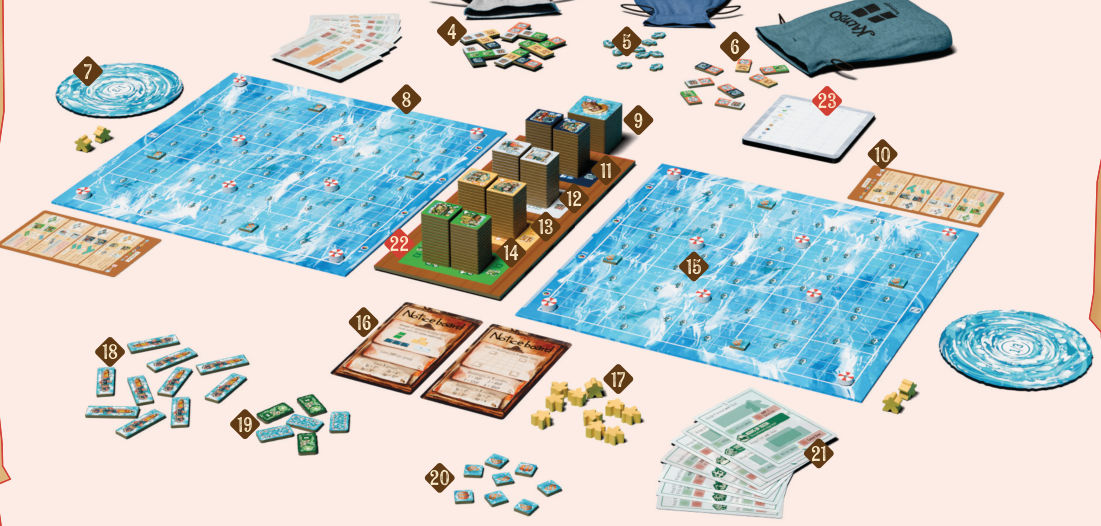
Everything happens on a grid of ocean, and everyone plays at the same time: there is no waiting for your turn.
Fish out the salvage
A Vortex holds 5 T-shaped tiles of salvage. You take one and pass the vortex on. Each tile shows five squares: wood, metal, rubber, seaweed, or useless plastic.
Lay the foundation
You place it edge to edge with what you've built: that's your foundation. When it covers a floating barrel or a life preserver, you collect the barrel or rescue a survivor.
Build on top
A full 2×2 square with at least 3 matching materials lets you lay a Building tile on it, and each Building has its own effect. A 3×3 with at least 5 matching takes a Monument: no effect, but 11 points.
Whoever you rescue from the sea is a survivor. Once they have a place in a Building, they become a settler.
The weather card of the round. It asks you for something by the end of the round.
Two cards set out at the start, each with a target for your settlement.
Buildings give you these. Boats go out to sea, nets bring in fish, and gardens grow on your settlement.
Same building, two games.
Tap the four squares to change the material. The barrels you collect count as any material; plastic can fill only one square. Every Building tile shows a different Building on each side, and you choose which one to keep.
Tap a square to change it.
What really changes between the two.
The tiles, the placement and the rounds are the same. The goal is not: in one you chase points, in the other every round is a test, and one missing requirement sinks the whole team.
Four phases, all at the same time.
Each round has a Forecast card: a weather event that asks you for something by the end of the round, such as Boats, Barrels, Fish, Gardens or Survivors.

Every Forecast is two cards in one: the top half is for playing against each other, the bottom half for all together. Apart from the title and one line of flavour, this is the text you read on it. Image from the rulebook, with its arrows.
Each Vortex is filled with 5 salvage tiles drawn at random from a bag.
Everyone takes one tile, places it and collects what it covered, each at their own pace; then you all pass the Vortex and repeat. You take 4 tiles a round; the last one left in the Vortex is discarded.
If your foundation completely surrounds a stretch of ocean, you also collect what's floating inside.
The solo game: you against the sea.
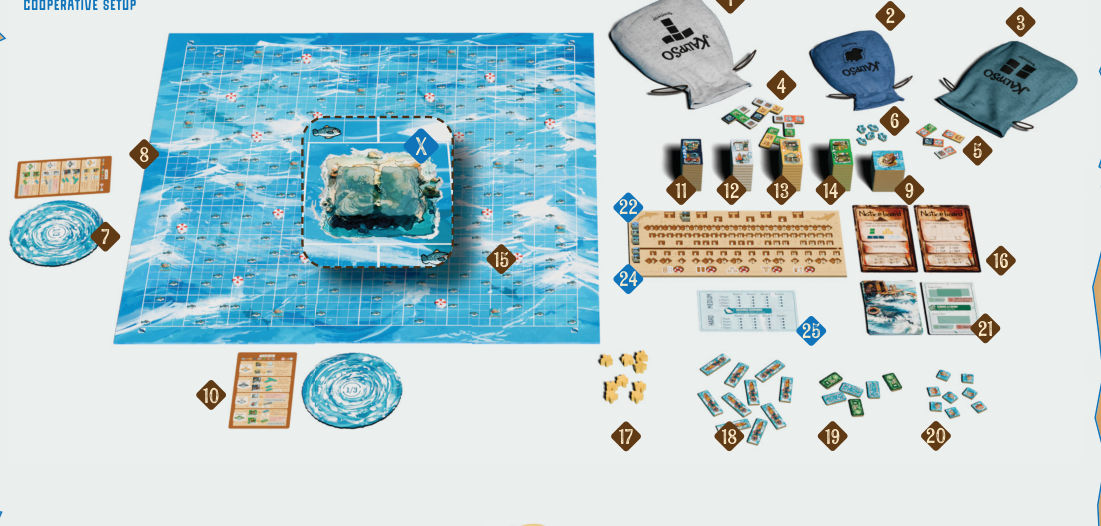
It uses the cooperative rules: the four boards joined around the island, the same checks at the end of each round, the two Settlement Goals to reach. There are no points. Your settlement either survives four rounds, or it doesn't.
Draw 2, keep 1
You draw two salvage tiles from the bag and place one. The other goes on the Resource Tracker and leaves the game at the end of the round.
5 a round, 20 in all
In the multiplayer game each player places 4 a round. Alone you place 5, and the whole ocean is yours to fill.
You are the Steward
You reveal the Forecast each round and keep track of fish, gardens, boats and settlers yourself.
One miss and it's over
A missed Forecast, a survivor without a home or a settler without food ends the game at once. Choose from four difficulty levels.
Your round, alone
You start with one tile: draw 2, attach 1 to the island, and the other goes back in the bag. The ocean is the same as in a four-player game, with 16 barrels and 16 life preservers.
- The Forecast completed. Set aside what the card asks for as you get it.
- A home for every survivor on the island. Each House you build moves one onto a Building.
- 2 fish per settler. Fish are eaten; any left over stay for the next round.
- Enough gardens. They are never used up: 3 gardens feed up to 6 settlers, 4 up to 7.
| R1 | R2 | R3 | R4 | |
|---|---|---|---|---|
| Learning | +1 | +1 | +1 | +1 |
| Easy | +1 | +1 | +2 | +2 |
If you rescued nobody else, that means 4 settlers and at least 20 fish over the game at Learning, 6 settlers and at least 26 fish at Easy. The Medium and Hard numbers are on the card in the box.
Everyone you pull from the sea is one more mouth and one more home to find. But the first five each unlock a permanent ability, such as placing the fifth tile of the round.
Of the 7 Forecasts you see 4, one a round. The rulebook warns that the art on the back of the deck gives clues to those paying attention.
Nobody passes you tiles and nobody can lend you a fish. Every turn is a choice between two tiles, and the one you refuse never comes back. The cooperative and solo modes were designed by Conor McGoey. If it's your first time, start at the Learning level.
Kalypso in eight answers.
Draft means you pick one tile and pass the rest; then you lay them to form patterns.
More to manage than a family game, far from a heavy euro.
Which tiles come out is random, but you always choose among several. Fish drawn from the bag add a touch of chance.
What you leave in the vortex and the Forecast you hand your neighbour. Nobody touches your board.
Same ocean, shared items and shared food: you decide together.
120 salvage tiles, 10 Settlement Goals of which 2 are used, 7 Forecasts per player, 4 difficulty levels in co-op.
That's the number BGG voters prefer. Every round is played at the same time, so there's almost no waiting.
A survival challenge against the sea, with a section of its own above.
Tiles are icons only. Forecasts have a couple of short lines in English: there's a real one in Phase 1. Goals also carry text.
A review from BoardGameCo.
The video is in English and spends most time on the cooperative game.

Is it the right game for your table?
You'll like it if
- you love fitting pieces together and watching something grow
- you want a competitive game with no one waiting for their turn
- you want a co-op where the pressure is real: fail once and it's over
- your group wants to step up from family games without a two-hour rulebook
- you often play alone and want a challenge you can actually lose
Skip it if
- you want a light family game: it's rated for ages 14 and up
- you want to attack your opponents directly
- you dislike losing the whole game because of one missed requirement
- you need everything in Italian: this edition is in English
Start with the competitive game.
That's the rulebook's advice too, because the cooperative is a bit harder. When you switch to it, start at the Learning level.
What people ask before buying
What kind of game is Kalypso?
A tile-laying and drafting game by Gilles Turbide, published by Inside Up Games, for 1 to 4 players, about 60 minutes, ages 14 and up, weight 2.3 out of 5 on BoardGameGeek. Over four rounds you build a floating settlement out of salvage from the ocean.
What's the difference between competitive and cooperative?
In competitive mode each player has their own ocean board and whoever has the most points after 4 rounds wins; failing a Forecast costs points. In cooperative and solo mode you share one ocean around an island, and win only by surviving all 4 rounds and reaching both Settlement Goals; failing a Forecast or a survival check ends the game at once.
How do you build a Building?
You need a completely filled 2×2 square of foundation with at least 3 icons of the same material among wood, metal, rubber and seaweed. Barrels count as any material and plastic can fill at most one square. Each material gives a choice of two Buildings: House or Cooper from wood, Solar Panel or Shipyard from metal, Scrapyard or Warehouse from rubber, Net Workshop or Greenhouse from seaweed.
What do Solar Panels, Fish and Gardens do in each mode?
In competitive mode they score points: Solar Panels for visible ocean around them, Fish for their value, Gardens for adjacent Buildings. In cooperative mode they keep you alive: Solar Panels set how many Boats you can launch, every settler eats 2 Fish per round, and Gardens must be enough to feed your settlers.
How much does luck matter?
Some. The tiles in the vortexes and the fish in the bag are random, but you always choose from several tiles. There are no dice.
Is there downtime?
Very little: every round is played simultaneously by all players, each at their own pace within each step.
How does the solo mode work?
It uses the cooperative rules on the shared ocean. There are no vortexes: you draw 2 salvage tiles, keep 1 and do this five times a round.
Which mode should I start with?
The rulebook recommends the competitive mode for a first game, because the cooperative mode is a bit more challenging. In cooperative mode, start with the Learning difficulty.
How many players is it best with?
BoardGameGeek voters prefer it with 3, on a range of 1 to 4.
How many difficulty levels are there?
In cooperative and solo mode there are four: Learning, Easy, Medium and Hard. They change how many survivors arrive each round.
Which language is it in?
This is the English edition. Tiles use icons only, while Forecast cards and Settlement Goals carry text in English.