
The Old King's Crown
The old king is gone and four factions contend for the throne. Each year you place three face-down cards beside the map's three bands, without knowing what the others have placed. Then they flip: whoever has the most Strength in a band gains Influence, and after 5 years the player with the most wins.
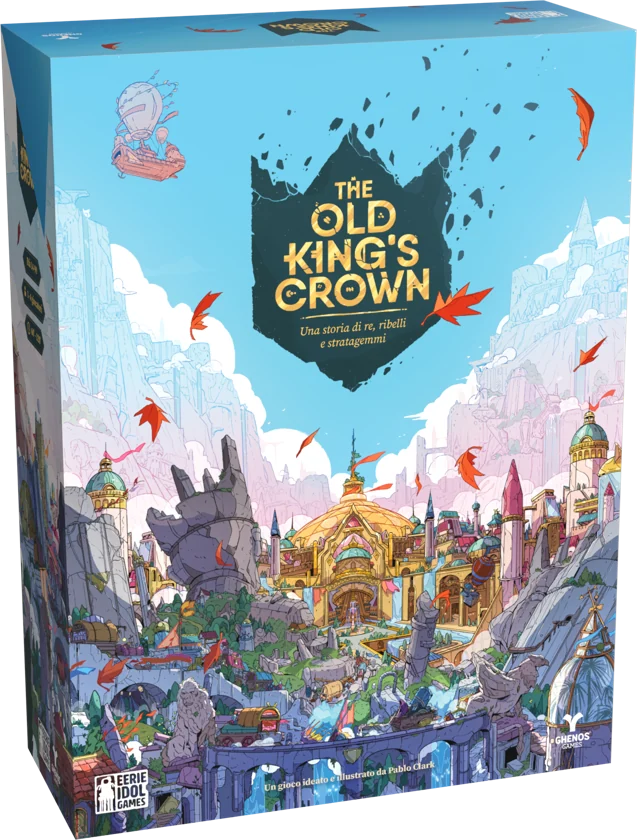
The game in eight answers.
You play with cards, all placed face-down and at once. Your deck improves with your faction's cards, but that is not the heart of the game.
↓Depth3.7 of 5 on BGGThe round is linear, but the rulebook is long and the first game requires consulting it. The weight is that of an expert game.
↓InteractionCompetitive, directYou steal each other's cards and victory points, and eliminate each other's cards.
↓LuckNo diceThe order you draw in and which cards appear to be won count. The real unknown is the others' face-down cards.
↓Replayability4 factions, 51 Kingdom cardsEach faction has its own powers and cards, and the cards to be won change every time. You choose 4, 5 or 6 years of play.
↓LanguageLots of text, in ItalianCards and board carry whole sentences to read. An example: move up to three Active cards and/or cards in your hand to the bottom of your deck, in any order.
↓SoloA true automa: the SimulacrumIt is not a score to beat: it is an opponent playing its own cards, with a difficulty system.
↓PlayersBest at 3, on BGGPart of the round is played all together; actions are taken in turn, which is where four players wait longest.
↓What do you play with?
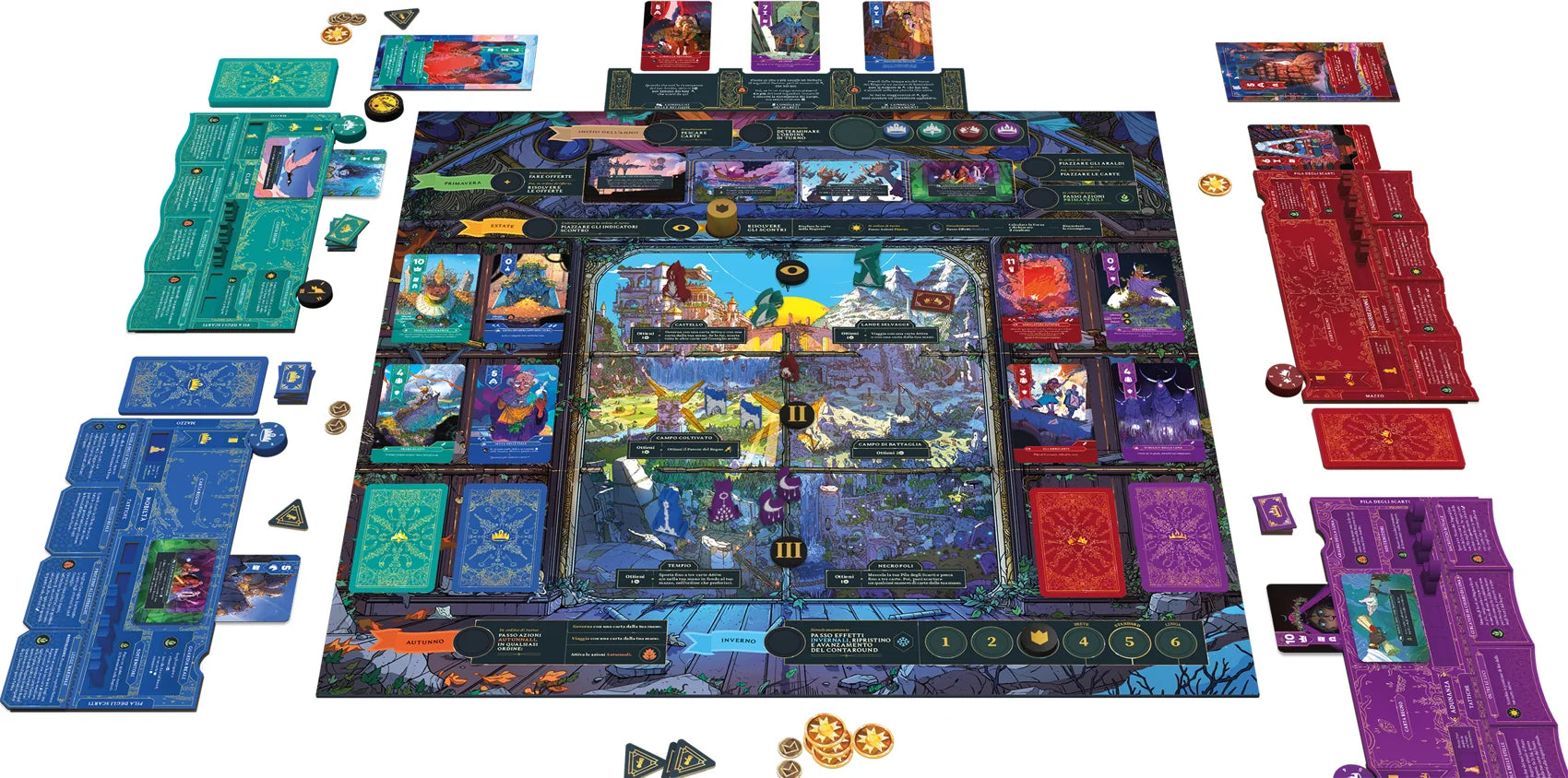
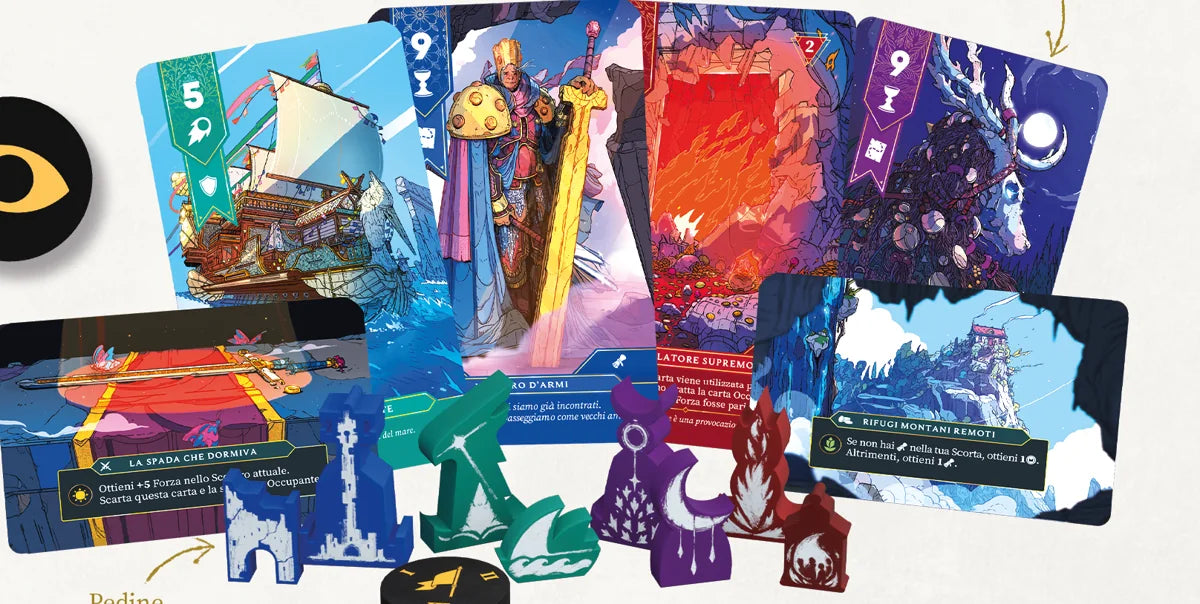
The pieces, in one minute
The map has three bands, the Regions, each with two Locations that give different rewards.
The Strength contest in a Region. Whoever wins takes the reward of a Location.
In Spring, a face-down card played to win a Kingdom card.
Where out-of-play cards and pieces end up, unless a power reclaims them.
The big number on a card. It is used in Bids and Clashes: whoever has the most wins.
Your main piece. You place it openly on a Location. If you win the Clash and choose that Location, you gain 1 Influence and steal 1 from opposing Heralds there.
Five pieces. Each gives +1 Strength in the first Clash of its Region, then goes to the Lost Pile.
The tokens that win the game. They also set turn order: whoever has the most acts first.
The currency to take your faction's strongest cards from your Site of Power.
Your personal pool of Advanced and HQ cards, the only cards that differ between factions.
Characters, places and artefacts that give you new powers. You win them by Bidding from the Great Road, the market on the board.
Three seats of power: Relics, Secrets and Oaths. A card with Vote icons placed there grants a bonus that grows with your Votes.
A contested token: while you hold it you have an action unique to your faction, up to three times, then it returns to the Harvest Field; it also breaks the final tie.
A face-up card next to a Region. Only Active cards fight.
What happens in one year?
A standard game lasts 5 Rounds, and each Round is a year with its seasons. Whoever has the most Influence at the end wins.
Start of the Year
You draw up to your hand size and turn order is reset: whoever has the most Influence acts first. If you must draw and your deck is empty, you shuffle your discard into a new deck and your hand shrinks by one for the rest of the game. This phase is skipped in the first Round.
Spring
Everyone bids a face-down card at once: whoever has the most Strength picks first a Kingdom card or steals one from an opponent, if the Bid beats the Strength of the card guarding it. The bid card stays to guard it. Then each player openly places their Herald on a Location and sets three face-down cards, one per Region. Finally, in turn, they may place Supporters.
Summer
The last player in turn order decides the order in which the three Regions resolve. Region by Region, cards are flipped, powers are used in turn, automatic effects resolve, such as cards that eliminate, and Strength is added up. The winner picks one of the Region's two Locations and takes its reward.
Autumn
In turn you may Govern, placing a card with Vote icons in a Council, and Journey, sacrificing a card to gain Lore, which you spend at your Site of Power. Once each, in any order, plus any autumn actions you have.
Winter
Winter effects resolve. Heralds return to the board, Supporters on the map go to the Lost Pile, Active cards go to the discard. Then the Round marker advances.
Can you read the table?
Your goal: end this Summer with more Influence than your opponent, the tokens that win the real game after 5 Rounds.
You win if you end the Summer with more Influence than your opponent. Three Clashes in a row, you against one faction, with the cards already placed. In each one you choose what to do; the cards you spend in one will not be there for the next. Each situation has different cards and a different order of Clashes.
The Clashes follow the rulebook's examples, but card values are examples and the opponent always plays the same way. In the real game you place your cards first, without seeing theirs.
What is a real game like?
Before You Play teaches the rules and plays a game, in English.

Where are the decisions?
One card, four fates
The same card can become a Bid, a blow in a Clash, a Vote in a Council or Lore for a Journey. Each use rules out the others.
At the table: Which card can I afford not to have?
The hand shrinks
If you must draw and your deck is empty you shuffle your discard, but your hand shrinks by one. Cards sent to the Lost Pile do not come back unless a power reclaims them.
At the table: How soon do I want to run out of deck?
The Herald is in plain sight
The Herald goes down before the cards, in front of everyone. It can show where you truly aim, or make the others believe something.
At the table: Am I declaring a plan or lying?
Bidding costs
The card that wins a Bid stays under the Kingdom card to guard it. A high Bid protects better, but takes a strong card out of your hand.
At the table: Do I pay dear to defend it or risk theft?
The order of Clashes
The last player in turn order decides which Region resolves first. It matters because powers can move a card to a Region not yet resolved.
At the table: Which Clash do I want the others to see first?
A Council can be emptied
Whoever takes the Castle reward places a card in a Council and removes all others, even their own.
At the table: Do I build there, knowing I can be thrown out?
Does every game change? It depends on the faction you pick.
The starting deck is the same for everyone. What changes are 4 Tactic tiles, strong powers mostly single-use; Advanced cards, powerful characters that join your deck; HQ cards, permanent powers; and the action granted by the Kingdom's Favour.
The Nobility
Backed by pernicious counsellors and imposing walls.
Pick it if you like: Strong defence and control you hold over time.
The Clans
Ready to plunder what past monarchs stole.
Pick it if you like: Mobility, momentum and overwhelming force.
The Uprising
A growing popular rebellion born in the cities, among the ash.
Pick it if you like: Scheming, careful feints and eliminating rival cards.
The Gathering
The mysterious masked cult recruiting by moonlight.
Pick it if you like: Card manipulation, subversion and slowly creeping power.
Does it work solo? Yes, against the Simulacrum.
A mode designed by Pablo Clark and Richard Wilkins, with its own components and rulebook in the box: 20 Faction cards, 24 Threat and Fog cards, 12 Ambition, 12 Scheme, 30 Forge.
Where the challenge comes from
From an automated opponent, the Simulacrum, which you operate through fixed instructions. It has no hand of cards. Ambition cards set its preferences each Round, Scheme cards decide where its Supporters and Fog go, and Bidding tokens from 2 to 12 replace its Bids.
What changes
Your rules stay those of the normal game. The Simulacrum instead ignores Kingdom card text and takes a bonus by the card's symbol, and it places Influence rather than cards in Councils, counting as votes. Each Spring it places face-down Fog cards next to some Regions: there the Threats already revealed on its board apply.
Your round alone
At the start of the year the Simulacrum reveals a new Threat. In Spring you bid normally while it flips a token, then you both place Herald and three cards: its cards are ordered by Tier, Gold, Silver and Bronze. In Summer you fight as usual. In Autumn you Govern and Journey; it places 1 Influence on a Council. You must choose where to stand before knowing where the Fog will fall.
How you win
At the end of the last Round you must have more Influence than the Simulacrum. On a tie, whoever holds the Kingdom's Favour wins. If it holds it, it reveals an extra Threat each Start of the Year: leaving it there is costly.
The Forge and difficulty
Two-sided Forge cards make the Simulacrum easier or harder. Difficulty is called Heat: Standard is 0, the booklet runs from -10 or less to 15 or more. Winning earns a trophy to note down, not an object in the box, whose type depends on Heat. There are pre-built Simulacra and rules to build your own.
Is it for you?
You will like it if
- you want decisions made in the dark, reading the others
- you like one card serving four purposes
- you want a solo mode with a true opponent
- you appreciate a game with very careful art
Skip it if
- you do not want to read text on cards
- you hate losing cards and Influence at others' hands
- you want a game you can teach in five minutes
For your first game, 5 Rounds.
It is the length the rulebook recommends. Solo, start with the Standard Simulacrum: the Forge comes later.
What people ask before buying
What kind of game is The Old King's Crown?
A competitive card-driven conquest game by Pablo Clark, for 1 to 4 players, 60-120 minutes, ages 14 and up, Italian edition by Ghenos Games, weight 3.7 out of 5 on BoardGameGeek. Each year of the game you place three face-down cards on the three Regions, and whoever has the most Strength in a Clash takes the rewards. Whoever has the most Influence at the end wins.
How do you win?
Whoever has the most Influence at the end of the last Round wins. On a tie, the player holding the Kingdom's Favour wins; if neither has it, the player higher on the Order Track.
How does a Clash work?
Each player places one face-down card for each of the three Regions. In Summer the cards of a Region are flipped together, powers are used and Strength is added up: the cards plus 1 for each Supporter. Whoever has the most picks one of the Region's two Locations and takes its reward. If their Herald is there, they gain 1 Influence and steal 1 from each opposing Herald on that Location.
What happens if a Clash is tied?
Tied players may play a face-down card or pass. If at least one plays, a new Clash begins, in which earlier cards and Supporters no longer count. If everyone passes, the Region has no winner and nobody takes a reward.
Are the factions different?
Yes. The starting deck is the same for everyone apart from the art. What changes are the Advanced cards and HQ cards bought with Lore, the four Tactic tiles and the action granted by the Kingdom's Favour. The Nobility leans on defence and control, the Clans on mobility and force, the Uprising on feints and eliminations, the Gathering on card manipulation and slowly growing power.
How much luck is there?
No dice. Luck lies in the order you draw from your deck and in the Kingdom cards that appear on the Great Road. The real uncertainty comes from the other players' face-down cards.
Is there a solo mode?
Yes, with its own components and rulebook in the box. You play your faction against an automated opponent, the Simulacrum, which has no hand of cards: it decides through its own decks and tokens. The Forge makes it easier or harder and lets you build new ones.
How long does it last and what is the best player count?
The box says 60 to 120 minutes, 1 to 4 players. You choose 4, 5 or 6 Rounds. On BoardGameGeek the best count is 3.
Is there a lot of text on the cards?
Yes, especially on the Kingdom cards and Advanced cards, and the first game requires reading them. This edition is in Italian.
What should I do in the first game?
The rulebook's recommended length is Standard, 5 Rounds. The solo booklet assumes you know the base rules, so read those first; then it recommends the Standard Simulacrum and, later, the Forge.
What crown will you wear?
Our assistant has read the The Old King's Crown - ITA rulebook. Ask whatever you like: you stay on this page.