
Windmill Valley: Duel
Two tulip growers in the same valley. Your actions come from a wheel that is geared to your opponent’s: every time you turn it you also decide what they get. By Dani Garcia, for two players.
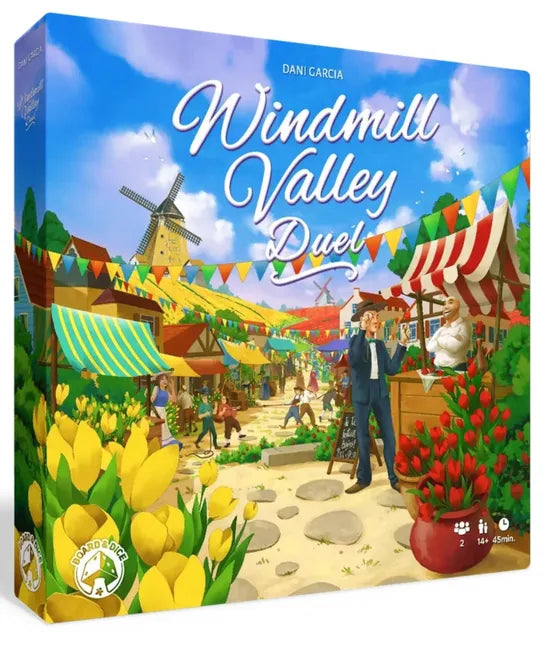
You turn your wheel.
Theirs turns too.
Here you do not pick actions from a list. A wheel gives them to you, and it is geared to your opponent’s.
Three wheels, one gear.
- You turn your wheel by 1, 2 or 3 spaces.
- You take one of the two spaces that touch: yours, or the central one.
- They take the central space on their side.
The two halves of the central wheel are the same. What you see there, they get.
Do you need Windmill Valley? No. It is a game of its own, made for two.

Eight short answers.
Plus planting, windmills, a market, double-use cards.
Depth2.6 of 5 on BGGShort turn. The hard part is what you leave them.
InteractionAll the timeNo direct attacks: almost everything is shared.
LuckLittle, no diceOnly in the setup and in which tiles and cards come out.
Length45 minutesAlternate turns until the Calendar runs out.
PlayersTwo. Only two.No solo mode: the wheels are built for two.
ReplayabilityEvery game set up differentlyWheels spun at random, tiles and cards shuffled.
LanguageEnglish, icons onlyYou never read during play. Rulebook in English.
What do you play with?
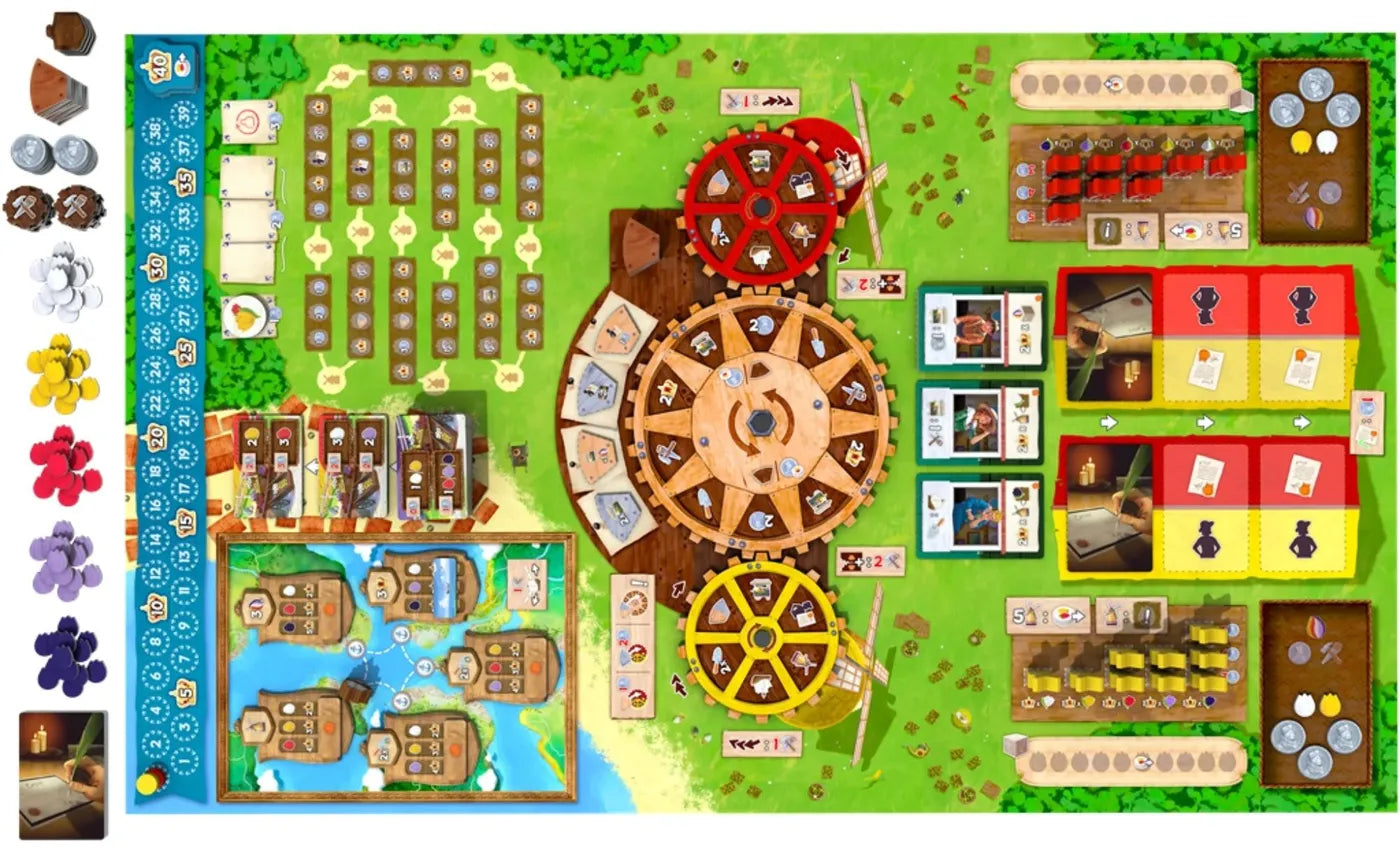
The game’s words. One line each.
Yours, 6 spaces. You turn it clockwise.
10 spaces in two identical halves. It turns the other way.
The coins: bulbs, windmills, enhancements.
1 to turn by 3, 2 for a second action, 1 per port to move the ship.
125 in 5 colours. Bulbs in storage, tulips once planted.
Shared rows. You plant from an end; after the first bulb, same colour as the neighbour.
9 each, one column per colour. They make the tulips next to them score.
Cards with two halves: a Helper (a power) for you, a Contract (points) for them.
What your opponent takes from the central wheel after your turn.
24 tiles that change the action of a space.
It marks time. When it reaches the end, the game finishes.
You deliver to the ship a bulb of the colour its port asks for.
Four moves. In this order.
Turn
By 1 or 2. By 3 for a Tool.
Choose
Your space, or the central one.
Pay, if you want both
2 Tools for the other action too.
They respond
With the central space on their side.
Do not want the central action? Skip it and take the Guilders shown by the Calendar. They can do the same.
How to read the wheels
the cart: you buy bulbs with Guilders
silhouette and letter: you take a card
you build one next to a patch
the ship: you deliver a bulb
the trowel: 2 bulbs (1 on the central wheel)
the wedge: a tile changes a space
the coin
hammer and saw
the crown
Two points for you.
Two points for them.
Turn the wheels below and see what you leave them.
Turn the wheels: what do you take, what do you give?
You are yellow, at the bottom. They are red, at the top.
The wheels are the ones on the board, without Wheel Enhancement tiles, and they turn as the gears and the rules make them turn. The situations, the Tools and the goals are examples: in a real game what you want depends on your patches, your windmills and your cards, and here we do not count Guilders and bulbs.
Nobody attacks.
Everybody gets in the way.
«Do I take it, if they get it too?»
The central action goes to both. And where you stop the wheels is where they start.
«Is this power worth the Contract I hand them?»
Your Helper is their Contract. A new card can push theirs out of the row: then they pay 1 Guilder to score it, or lose it.
«Which colour do I open this patch with?»
Whoever plants first at an end chooses the colour for that side. The windmill spaces are for both.
«Do I spend Tools to bring it to my port?»
One ship for both. After a delivery the port can close and the ship moves on.
The Calendar runs. Then you count.
It moves forward when
- someone reaches 40 points
- someone builds their 5th windmill
- someone makes their 6th Foreign Trade
- the Wheel Enhancements, the Farm Enhancement deck or the Market run out
At the last space: even out the turns, one last turn each, and count.
What scores
- during the game: patches, windmills, ship, central wheel
- at the end: the Contracts left on the board
- at the end: tulips, but only next to your windmills
- tie: most Guilders, then most Tools
At most 1 for white and yellow, 2 for red and violet, 3 for black. Two of your windmills next to the same patch: it counts twice. The rulebook’s example: 6 yellow tulips are worth 6, 6 black tulips 18.
Rules and a full game, from Gaming Rules!
The video is in English. The rules take about 9 minutes, then a whole game.
You turn the wheel.
You both decide the game.
Is it for you?
You will like it if
- you often play in two and want every choice to touch the other player
- you like games with everything open on the table, to be read
- you want a medium-weight strategy game that fits in 45 minutes
- you want a game with no text: icons only
Skip it if
- you want to play alone or with three or more
- you prefer games where everyone builds on their own
- you do not enjoy weighing what you leave to the other player
Look at the central wheel first.
What comes out there, they get it whether you take it or not. If it helps them more than you, turn by a different number.
What people ask before buying
What kind of game is Windmill Valley: Duel?
A strategy game for two by Dani Garcia, published by Board&Dice. 45 minutes, ages 14 and up, weight 2.6 of 5 on BoardGameGeek. You grow tulips: you plant bulbs in shared patches, build windmills and ship bulbs abroad. Your actions come from three geared wheels, so every time you turn yours you also decide what your opponent gets.
Do I need Windmill Valley to play?
No. It is a game of its own, by the same designer and set in the same world, made for two. The box has everything you need.
How do the wheels work?
On your turn you turn your personal wheel clockwise by 1 or 2 spaces, or by 3 paying a Tool. The central wheel turns the other way and your opponent’s turns with yours. You take the action of one of the two spaces that touch (on your wheel or on the central one), or both by paying 2 Tools. Then your opponent takes the action of the central space next to their wheel, or the Guilders shown by the Calendar instead.
What are the Farm Enhancement cards?
20 cards with two halves. The half facing you is a Helper, a power that triggers when you take the action drawn on the card, once per turn and only on your turn; the other half is a Contract for your opponent, worth points. When you take a card as your Helper you give them a Contract; when you take it as your Contract, they get a Helper.
How do you win?
With the most points. You score during the game (patches, windmills, Foreign Trade, central wheel, Contracts) and at the end: Contracts still on the board and tulips. Each tulip is worth 1 to 3 points depending on the windmills built from the column of its colour, and only counts in patches with one of your windmills next to them. Tie: most Guilders, then most Tools.
When does the game end?
When the Calendar reaches its last space. It moves on six kinds of events: 40 points reached, a player’s 5th windmill or 6th Foreign Trade, and the Wheel Enhancement stack, Farm Enhancement deck or Market stack running out. Then you even out the turns and each player plays one last turn.
How much luck is there?
Little, and no dice. Luck is in the setup (wheels spun at random, tiles and cards shuffled), in the order in which tiles and cards come out. Everything else is open on the table.
Can you play it solo or with three?
No. It is for exactly two players, with no solo mode.
Do I need to know English?
The edition is in English, but board, wheels and cards use only icons: according to BoardGameGeek you do not need to read during play. The rulebook is in English and its last two pages explain the icons.
How long does a game take?
45 minutes according to the box. There are no fixed rounds: you alternate turns until the Calendar reaches the end.
What is in the box?
1 board, 1 central wheel with its base tile, 2 personal wheels, 3 plastic pins, 125 tulip bulbs in 5 colours, 18 windmills (9 per colour), 20 Guilders, 14 Tools, 24 Wheel Enhancement tiles (12 wooden, 12 silver), 20 Farm Enhancement cards, 12 Market tiles, 5 Demand tiles, 5 Port tiles, 11 Export tiles, 1 ship, 1 Calendar marker, 2 score markers and 2 40/80 point tiles.
Turn the wheel. Then look at what you left them.
Our assistant has read the Windmill Valley: Duel rulebook. Ask whatever you like: you stay on this page.