

| Written on the two regulations | July 31, 2026 |
The question everyone is asking is whether this is the usual Cascadia with stackable tiles. I put the two rulebooks side by side, and the honest answer is that the two halves of the game have swapped places.
Five points: who made it, how new it is, how much the box is worth, how well-crafted it is, how self-explanatory it is.
| FrogScore | 8 / 10 |
|
Signature
I am the author and illustrator of Cascadia, Spiel des Jahres 2022, and 9.5 is the ceiling.
|
9.5 | |
|
Originality
Habitats and animals swap scoring methods, while the turn remains identical.
|
6 | |
|
Craftsmanship
84 double-sided tiles and 90 solid wooden pieces, with sixty euros remaining fifteen above the first.
|
7 | |
|
Attention to Detail
Twenty scenarios and two variants, with two pages dedicated to clarifying the cards.
|
9 | |
|
Self-sufficiency
No words are needed on tiles and markers, while clarifications are only found in the rulebook.
|
8 |
Each item also explains why it's not higher, and the evidence is in the section below. The FrogScore only includes what no one would want in smaller doses, so weight, randomness, and interaction are excluded and can be found in the profile.
| Buy it if | you like the Cascadia puzzle and enjoy the idea of the board changing under you |
| Leave it if | you own Cascadia, still enjoy playing it, and are looking for something better rather than just different |
| Window | no Italian edition announced, but the original in Italian exists: waiting is not unreasonable |
We import it · see Cascadia: Alpine Lakes on Frogames
| Interaction | low, only competing for pairs in the center of the table | |
| Randomness | depends on the pairs that come out, correctable with nature tokens | |
| Weight | the rules are few, the real challenge is scoring | |
| Downtime | short turns, and those who think too much make themselves known | |
| Footprint | a personal environment that grows in width and height |
| Mechanics | Tile placement · paired drafting · stacking and height · pattern building · variable objectives · majorities · solo with scenarios |
|
Players
1 to 4
with 43, 63 or 83 tiles depending on player count
|
Duration
30-45 minutes
exactly 20 turns each
|
|
BGG Weight
2.36 out of 5
ages 10 and up
|
Language
Independent
only the rulebook is in English
|
|
Habitat
Three, plus lakes
the first Cascadia had five
|
Solo
With 20 scenarios
with a score chart from 60 to 120
|
The two halves have switched places
In Cascadia, the cards that change from game to game are the animal cards, four versions per species, and each time the bears or eagles ask for a different pattern. The habitats, however, always score the same way: one point per tile in the longest corridor, plus majorities at the end of the game.
Here, it's exactly the opposite. The variable cards are those of the habitats; animals only score points based on how high you manage to stack them, and majorities have shifted to them. The turn remains identical: you choose one of the four tile and animal pairs in the center of the table and place it in your environment, while what you are building has become something else.
| Cascadia | Alpine Lakes | |
| Habitat | fixed points | variable cards |
| Animals | variable cards | points for height |
| Majorities | on habitats | on animals |
| Tiles | one hexagon, flat | two hexagons, stackable |
Stacking tiles does something that couldn't happen in the first Cascadia, because the habitat under an animal stops existing forever. You place a puma in a forest, and fifteen turns later that puma finds itself on a glacier, as you've built over it in the meantime. The rulebook warns of this in a sidebar, reminding you that raising the environment will change the terrain under the animals. Points follow the same ascent, because each lake counts for the levels it gains and animals score from the third level up.
You are not filling a grid. You are burying what you did before.
| Doubt |
You learn it in five minutes, then you discuss it for twenty The rulebook dedicates two entire pages to clarifying how to read the scoring cards, one for habitats and one for environment cards, and that's a sign that those cards alone are not enough. Confirmation can be found on the forum, where four discussions on specific cards have already opened in the first few weeks. Those coming from the first Cascadia expect a game that can be explained in an instant, and for the rules, this is true, while for scoring, it's advisable to keep the rulebook handy. |
|
You've just read the pros and cons, and what follows is to weigh them. If that's enough for you, the path is short.
See Alpine Lakes on Frogames →
|
The same team, complete
Randy Flynn designed Cascadia, which won the Spiel des Jahres in 2022, and here he reunites with Beth Sobel for illustrations, Dylan Mangini for graphics, and Shawn Stankewich for the solo mode with its twenty scenarios. It's the same team, brought back to the same table within the Flatout Games collective with AEG, instead of farming out the sequel to someone else while the name sells itself.
"If you play it exactly like Cascadia, you'll do terribly."
Luiz Mendes, review on BGG
|
84
double tiles
|
90
wooden tokens
|
27
environment cards
|
The twenty-seven environment cards are the advanced level, and the authors advise leaving them in the box until the rest is clear. Above them are five new species: puma, eagle, marmot, mountain goat, and pika, plus four initial four-hexagon tiles, with which you start already in the middle of a puzzle instead of from a single point.
The price must be faced, because fifty-nine ninety-nine is fifteen euros above the foreign average of the first Cascadia and twenty above the Italian edition, for the same weight and duration. Part of the increase is indeed in the box, with the double tiles being twice the cardboard and the cards increasing from twenty-one to forty-two. The rest you pay for the name.
The box also works when you're alone at the table, and it does so without an automatic opponent. You set up a two-player game, and each turn, the pair furthest from the decks disappears from play, using the same system as the first Cascadia. The pressure comes from what passes you by and won't return, rather than from someone blocking you.
|
60 points
a good start
|
90 points
excellent
|
120 points
the top of the chart
|
Above the table are twenty scenarios, each with three thresholds, and thirty-five objectives to tick off on a map to be completed with a pencil. This is the part that the first Cascadia already had and which has grown here, so if solo play is the reason you buy, this box has many evenings within it.
|
There is
Twenty scenarios and thirty-five objectives
Family and intermediate variant Complete solo play A bonus card for the original Cascadia |
There isn't
Italian edition announced
Direct interaction Compatibility with expansions of the first A cooperative mode |
Sources · official rules of Cascadia and Cascadia: Alpine Lakes, BGG page, public author responses on the forum. Where the rules do not cover, I have not filled in with my own words.
Same hands, same turn, same half hour. Only this time what you build first ends up underneath.
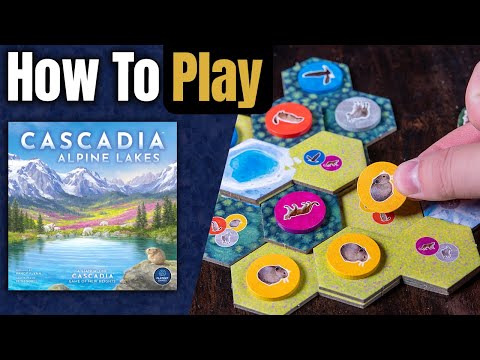
|
10 minutes
Learn to play in ten minutes
kovray · helps you understand if this type of puzzle is for you, before spending sixty euros
|
We're bringing it to Italy.
BGG Page · boardgamegeek.com/boardgame/446815


 https://frogames.business
Share:
Parks Europe vs. Parks 2E: everything that changes, according to the rules
Timespan: four cards in a row decide your civilization