
Tag Team Arthur's Legacy
A two-player fighting game: you prepare the deck, then you watch it fight.
Excalibur, Merlin, Morgan, Perceval, the Dragon and the Green Knight in the ring. You pick two, and your deck is never shuffled: the whole game is deciding where to slip the next card.
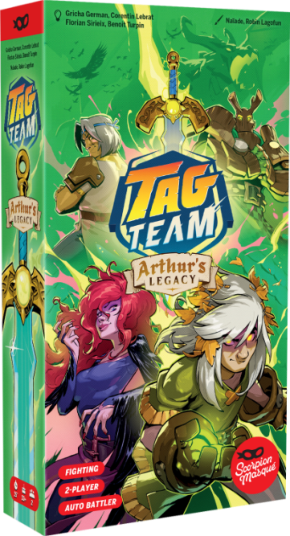
Your deck is never shuffled.
Each player controls a team of two fighters and starts with a deck of just two cards. A deck that keeps its order means one thing: you know what your opponent played, and in what order.
Fight
You each turn over one card, together, and do what it says: that's a turn. When the deck runs out, the round ends. During the fight you can't change anything: you watch how it goes.
Build
You draw 3 cards from the reserve of your two fighters, keep 1 and slip it secretly anywhere in your deck, without moving the others.
One card longer
Next round the deck has one more card. You carry on until a fighter's health reaches KO: just one KO and the game is over.

- Attack: the opposing fighter loses as much health as your fighter has Power, shown by the purple cubes.
- Block: cancels the Attacks of that turn. If it actually stops one, it usually gives a bonus.
- Power: what you gain in a turn only counts from the next turn, because everything happens at the same moment.
- The card you reveal decides who fights: if it belongs to one of your two fighters, that one is in the ring and the other is the partner.
Where do you slip it?
Round 2. You have seen your opponent's two cards. Now you add a Block: choose where it goes, then see what happens depending on where they put theirs.
Simplified example with the basic actions from the rulebook, both starting with 1 Power and a Block that gives +1 Power when it stops an Attack, like Steel on Steel. Real cards have extra effects.
Each one plays by their own rule.
Every fighter has a deck of 10 cards and one mechanism found nowhere else. Your team is two of them. Dots show the complexity printed on each board.
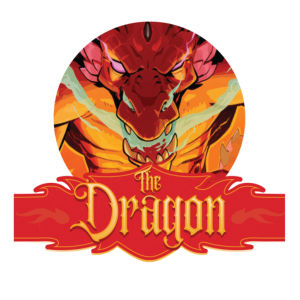
The Dragon
Scales. Each Scale on his board stops 1 point of an Attack and is then lost. He can hold up to five. They don't stop Direct Damage, which is a loss of health that isn't an Attack.
For you if you want to learn the game with a fighter who forgives mistakes.
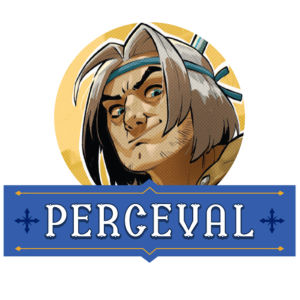
Perceval
The Knight Errant. His Attack is worth his Power cubes plus the number of his cards already played this round, including the one being played. The further into the round, the harder he hits.
For you if you like building up to one big hit at the end of the deck.
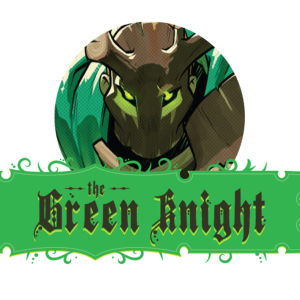
The Green Knight
The more he bleeds, the harder he hits. Almost every space of his health track adds temporary Power to his Attacks: with 2 cubes on space 6 he attacks for 5. He can regenerate, but the Greenwood Mask comes down during the fight and lowers his maximum health.
For you if you enjoy walking close to KO on purpose.
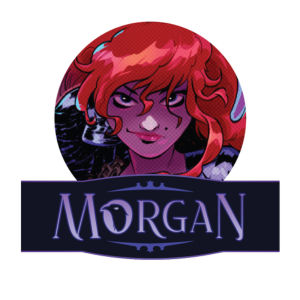
Morgan
The Crow's Eye. In every Build step your opponent chooses first and must show her the card. Only then does she draw. She knows what's coming, but not where it will be slipped in.
For you if you want to play with one more piece of information than your opponent.
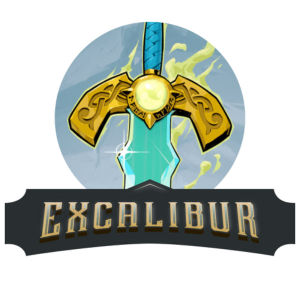
Excalibur
The Broken Blade. When its health reaches the last space you don't lose: the sword breaks and its board flips. From then on it can neither lose nor gain health, and the «When Broken» effects on its cards come into play. Yes, the sword is a fighter.
For you if you like a partner who changes the game when it falls.
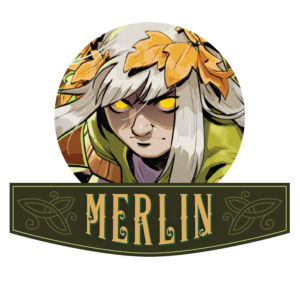
Merlin
The Trees. He has an extra board with four branches: Attack, Block, Heal and Direct Damage. His cards move markers along the branches, and when he activates the Trees he performs every action his markers are sitting on.
For you if you want to build your own moves during the fight.
Do you need the first Tag Team? No.
Arthur's Legacy is a complete game: you don't need any other box to play. Every Tag Team box mixes with the others, so a second box adds fighters, not rules to relearn.

Arthur's Legacy
6 fighters: 15 possible teams. €18,99
With the first Tag Team
18 fighters together. On its own the first box has 12 fighters and 66 teams. See the first Tag Team
SNK Arcade Legends
Another Tag Team box, with fighters from SNK video games. Pre-order · €18,99
Tag Team in seven answers.
You add cards to your deck, then the fight runs by itself: you choose before, you watch during.
The box says 15, BGG 20. The deck grows by one card a round, so the game speeds up by itself.
Luck is in which 3 cards you draw from your reserve. You always choose 1, and the order of the deck is yours.
Few rules, but every fighter changes them. Rated 8.1 on BGG, from only 144 votes so far.
No solo mode and no way to play with more: it's a duel, and everything hits your opponent.
Each team plays differently, and the same fighter changes depending on the partner.
Cards have icons and a short line of text; rules and the Fighters' Guide are in English too.
All six, one by one.
A Before You Play overview of the fighters. The video is in English.

Is it the duel for you?
You'll like it if
- you often play as two and want a game that fits in 15 minutes
- you enjoy guessing what your opponent is planning
- you like characters who each break the rules in their own way
Skip it if
- you usually play with three or more, or alone
- you want control during the fight: once it starts, your choices are made
- you need everything in Italian: this edition is in English
First fight: the teams from the rulebook.
Excalibur and the Green Knight against Perceval and the Dragon. Then use the Draft cards and pick your own team.
What people ask before buying
What kind of game is Tag Team: Arthur's Legacy?
A two-player fighting card game, a mix of deckbuilder and auto battler, by Gricha German, Corentin Lebrat, Florian Sirieix and Benoit Turpin, published by Le Scorpion Masqué. It takes about 15 minutes, from age 10, and weighs 2.67 out of 5 on BoardGameGeek.
Do I need the first Tag Team?
No. Arthur's Legacy is a complete standalone game. All Tag Team boxes are compatible: combining it with the first box takes you from 66 to 153 possible teams. Do not combine two copies of the same box.
How does a round work?
Two steps. Fight: both players reveal one card at a time and carry it out, until their Fight deck runs out. Build: you draw 3 cards from your Build deck, keep 1 and secretly slip it anywhere into your Fight deck without changing the order of the other cards. The deck is never shuffled and starts with 2 cards.
How do you win?
By bringing one of the opposing fighters to the KO space: one is enough. If fighters of both teams are KO'd in the same turn, the game is a draw.
Can you give an example of where to slip a card?
If your opponent's deck reveals an Attack on the second turn, a Block placed in second position stops it and, on a card like Steel on Steel, gives you +1 Power. But your opponent has secretly added a card too, so their Attack may have moved one place later.
What do the six fighters do?
The Dragon stops Attack points with his Scales. Perceval's Attack grows with the number of his cards played in the round. The Green Knight attacks harder the less health he has. Morgan sees the card her opponent adds in each Build step. Excalibur doesn't lose when it reaches the last space of its track: it breaks and its Broken effects start. Merlin builds his moves on an extra board with four branches.
How much does luck matter?
Little. There are no dice: luck lies in which 3 cards you draw from your Build deck, of which you keep one, and the order of your Fight deck is always your choice.
Can it be played solo or with more than two?
No, it is a game for exactly two players.
Which language is it in?
This edition is in English. Cards use icons and a short line of text; the rules and the Fighters' Guide are in English too.
What's in the box?
6 Fighter boards, 1 Tree board, 60 Fight cards, 6 Draft cards, 6 tokens, 40 Power cubes, 4 Health markers, 1 Greenwood Mask marker, 4 Special markers, the Fight Rules and the Fighters' Guide.
Round 2. Fight.
In the box: 6 Fighter boards, Tree board, 60 Fight cards, 6 Draft cards, 40 Power cubes, markers and tokens, Fight Rules, Fighters' Guide.